

|
|
|
www.niger-meteorite-recon.de
Bassikounou Meteorite Fall
go to page
1
2 |
3 |
4 | 5 |
Maps & Appendix

By Svend Buhl & Matthias Baermann
|
Petrography and chemical analysis
All the mineralogical and petrographic testing has been
done at the University of Bern, Switzerland and the Museum
of Natural History, Switzerland by the skilled team of
E. Gnos, B. Hofmann and M. Eggiman. These are their results:
« Electron microprobe analysis yielded olivine Fa18.6,
pyroxene Fs16.3 Wo1.1, plagioclase An13.7. Mean olivine
composition determined by XRD is Fa17.3. Mean chondrule
size 0.35 mm (n=53). Metal abundance is 8 vol%, troilite
6.6 vol%. Mean size of plagioclase grains is ~20 mm.
Troilite is polycrystalline, rich in silicate inclusions,
and shows diffuse boundaries to metal. Metal is
partly rich in silicate- and troilite inclusions. Rare metallic
Cu (10 mm) at kamacite-taenite boundaries and in troilite.
Shock stage is S2, some shock veins are visible, no weathering (W0). »
|

|
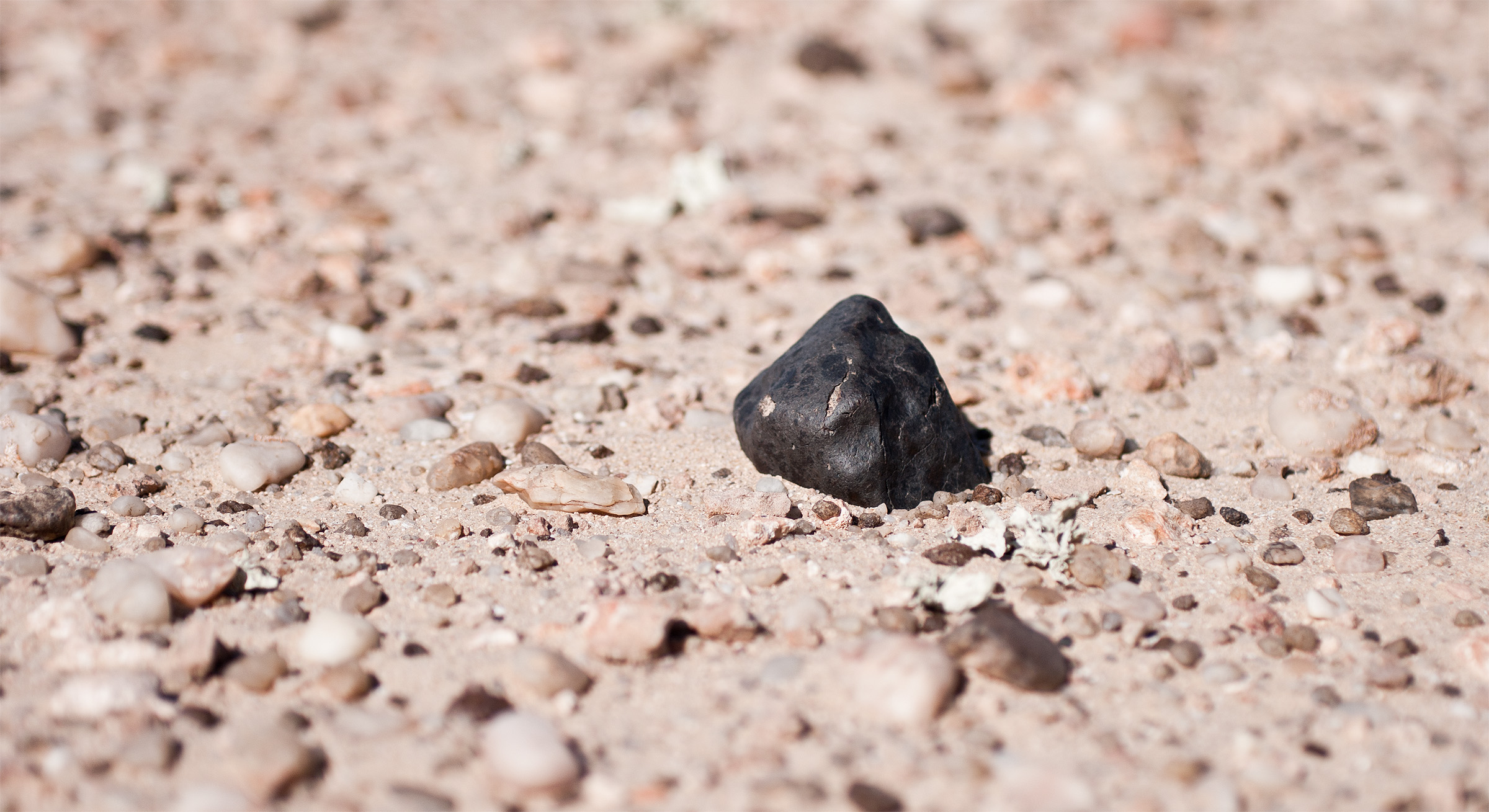
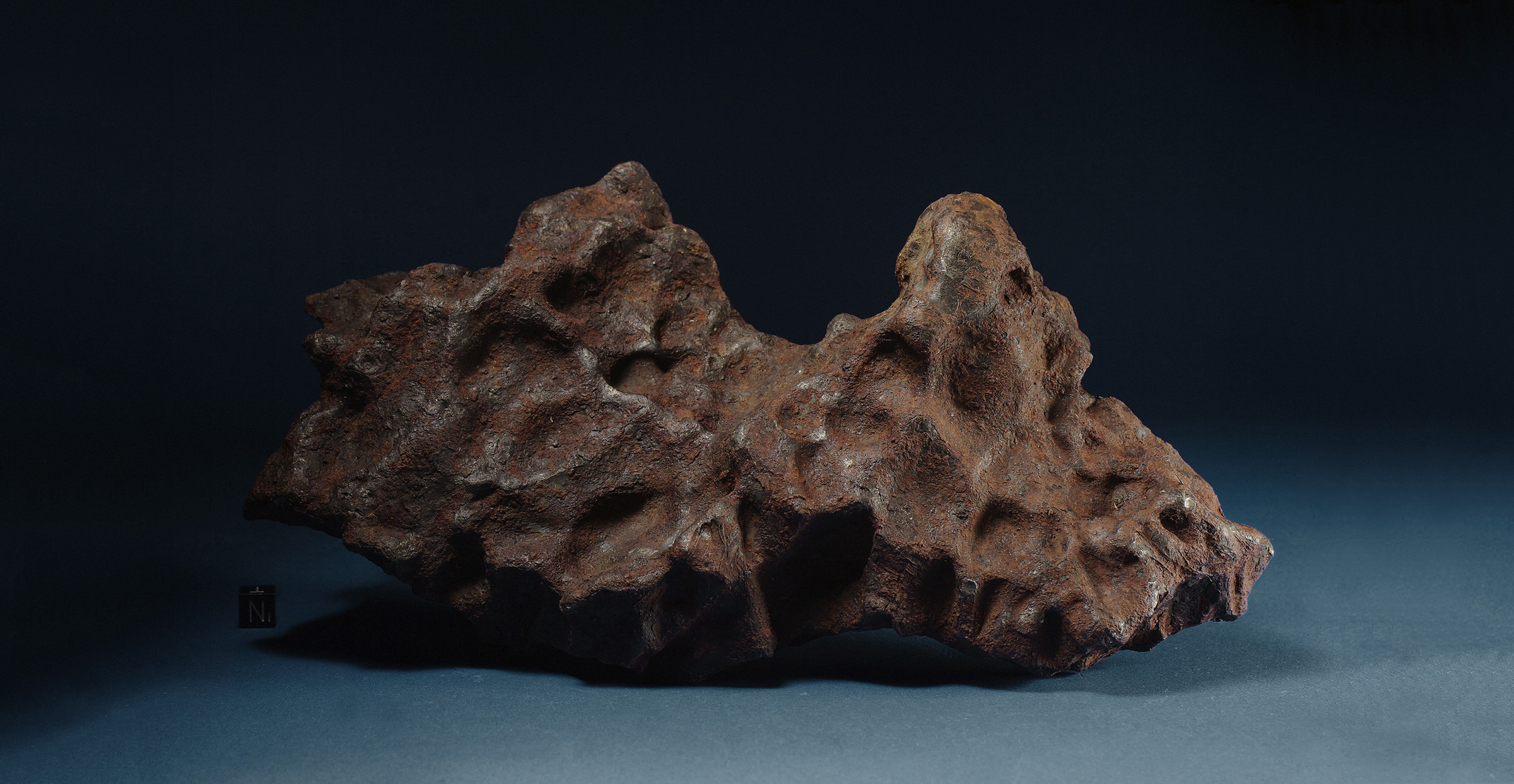
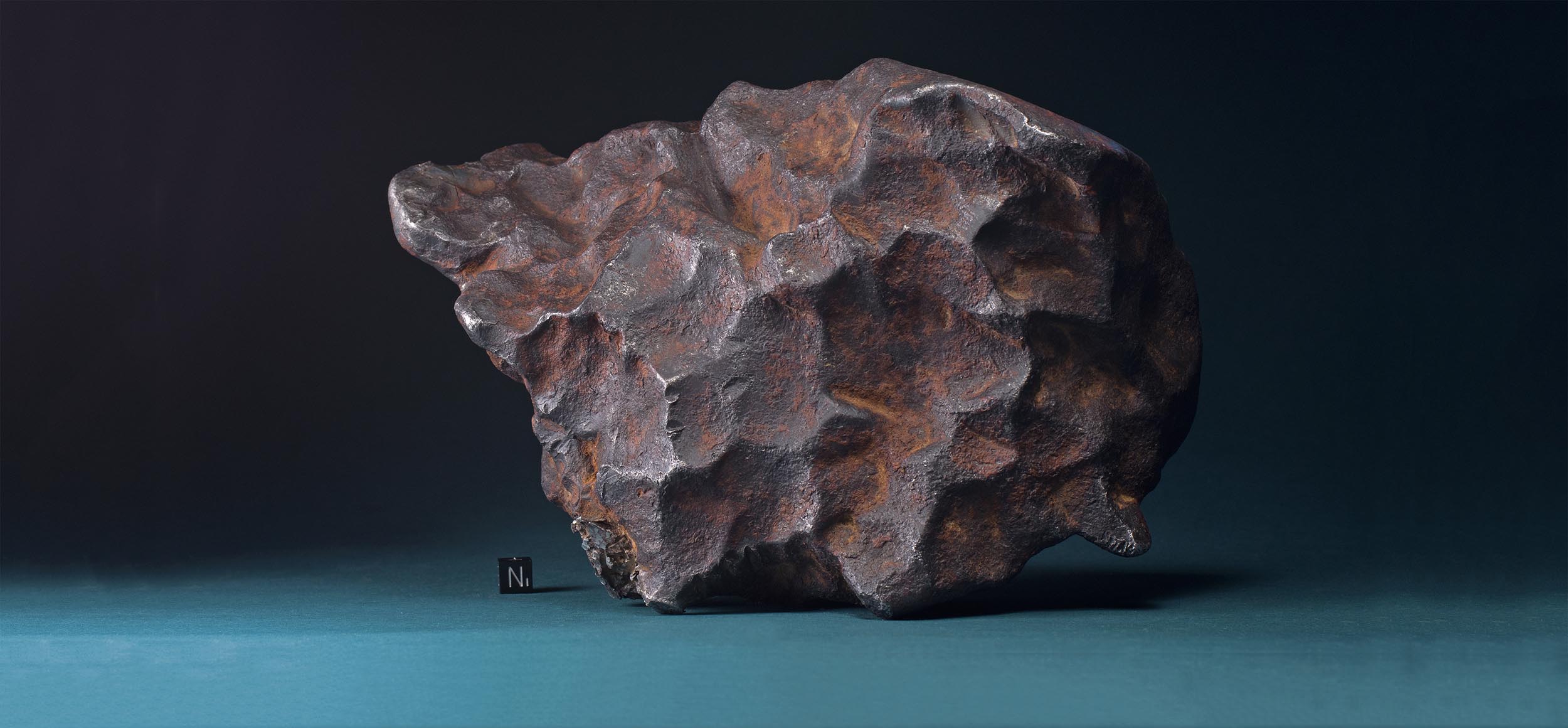
1120gm fragment showing beginning oxidation on the heavily
regmaglypted crust. Photo courtesy of Tomasz Jakubowski
|
|
The cosmogenic radionuclides measured by Patrick Weber from
the Particle Physics Group, Institute of Physics,
University of Neuchâtel are consistent with a recent
fall in October 2006:
« Gamma-spectroscopy performed in December-January
2006 showed the presence of the following radionuclides:
48V, 46Sc, 56Co, 54Mn, 58Co, 7Be, 51Cr, 57Co, 22Na, 26Al
and 60Co. Recalculated to 12 October 2006 22Na was
38.0±2.2 dpm/kg and 26Al 31.5±2.1 dpm/kg, the activity
ratio of 1.21 is fully consistent with a fall on that
date.»
There is however a slight inconsistency between
the dates of October 12 resulting from these measurements
and the fall date of October 16 as announced in the local
press and as declared in the eyewitness accounts.
This inconsistency may be within the tolerance of
the gamma-spectroscopy data obtained.
The classification of the Bassikounou meteorite as
submitted to the NomCom is that of an ordinary
chondrite (H5), with a shock stage of S2 showing
no weathering (W0).
Historic importance
Prior to the Bassikounou event a total of eight meteorites
plus two crater structures were known for Mauritania.
Among those are six finds and only two falls. Aioun el Atrouss,
a diogenite weighing 1000gm fell at Gounquel in south-east
Mauritania on April 17 in 1974. Kiffa, an ordinary chondrite
of a TKW of 1500gm fell on October 23, 1970 at 14:55hrs.
Bassikounou, the third registered fall in Mauretania is
by far the largest and best documented fall in the
history of the country.
|

|
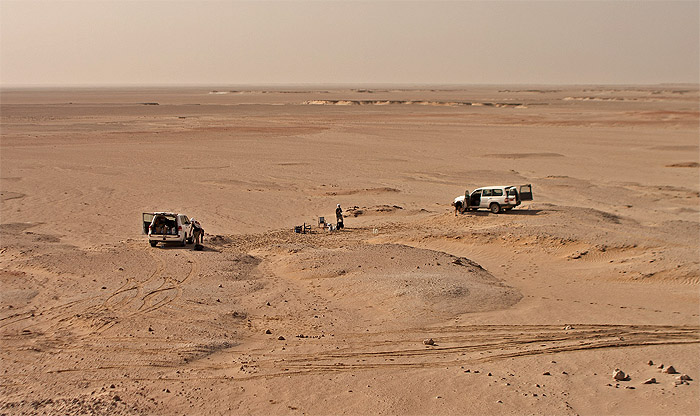
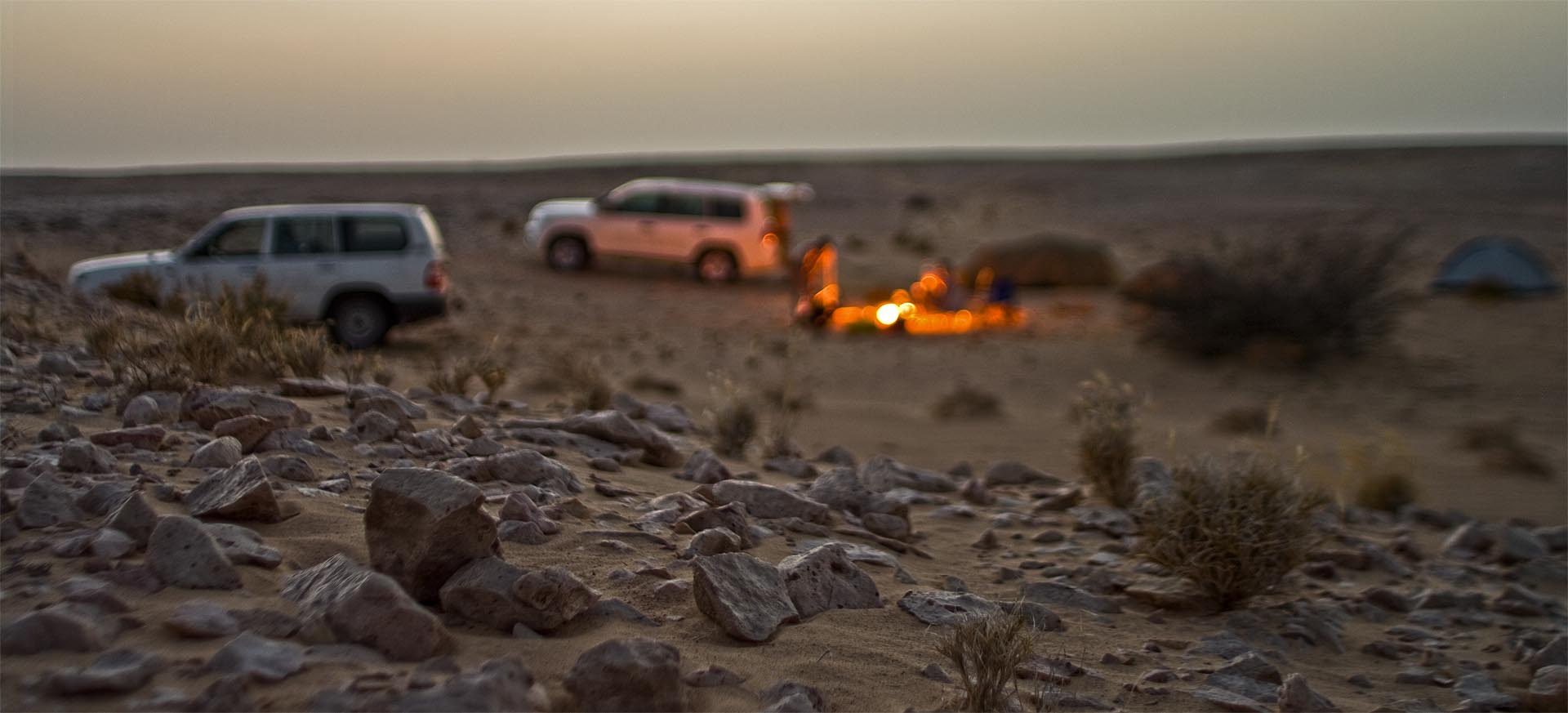
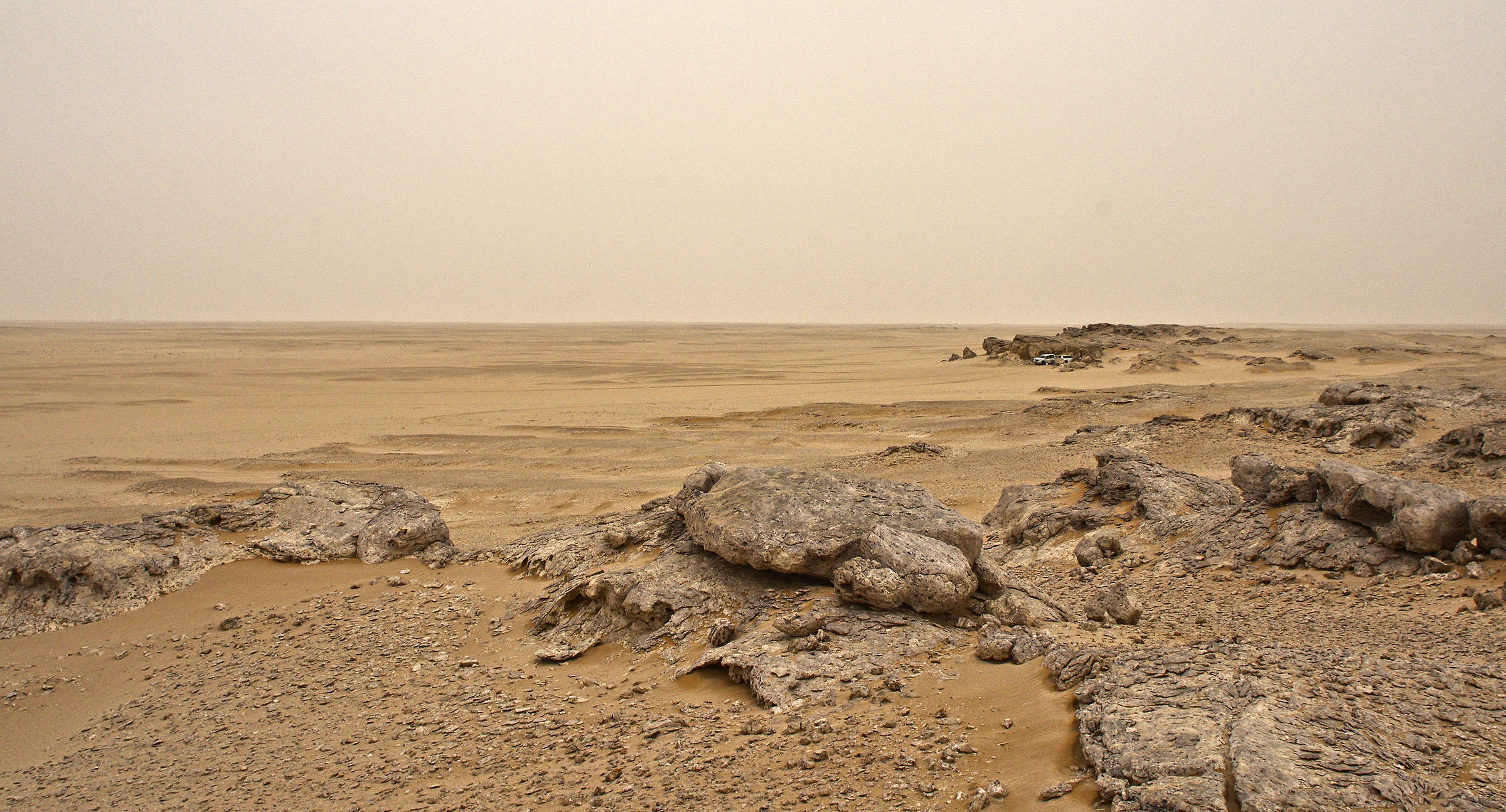
Sunset on the strewn field. Image shows the Olimjam ridge
viewing north-east towards Oum Sdeira. Image courtesy of Mohamed Zeroual |
|
Initial mass and total known weight
It is known that ordinary chondrites
loose between 50 and 85% of their
mass due to ablation. The exact loss quotient is
depending on initial velocity and entry angle,
with maximum ablation beginning in altitudes from 80 to 125km.
Unfortunately these required values can not be
derived from the fragmentary observations
of the Bassikounou bolide.
Pending further observation data the authors are
at present unable to provide a proof calculation
on the initial fallen mass. A large but
unknown number of meteorites that were collected
is in the hands of Army officials. Neither the
individual weights nor the number of
meteorites seized and collected by the Mauretanian Army is
known.
To the knowledge of the authors there is also no data from gamma
ray spectroscopy available that would allow to derive
the initial mass by different depth production
ratios of certain cosmogenic radionuclides.
Taxonomic catalog of the recovered masses
To gather information on the total recovered weight, the
mass distribution and the general characteristics of the
meteorites recovered the authors approached finders, local
citizens, mineral dealers and collectors with a request
for information on the masses obtained. Many owners and
dealers in the possession of Bassikounou meteorites answered.
At present (June 30) the TKW is 93.85kg.
|

|
False color satellite image with trajectory of the
Bassikounou fireball (white) and distribution ellipse (red).
Arrows indicate the respective azimuth of the fireball sightings
from the Dhar al Nema (1), from Bassikounou (2), Koussana (3) and Oum Sdeira (4).
The sighting from Bassikounou towards the east is most probably erroneous for
the fireball should have already ceased east of Bassikounou
|
|
In the later stage of the undertaking, in June
2007, a steady average of 20 meteorites
per month were reported to the authors. But of the
22 individual masses submitted in June 2007 21 had
already been catalogued previously either individually
or under a lot. Judged by this
number of particular meteorites that were sent in
redundantly either from finders, dealers or end owners
it can be said that the current
catalogue covers approx. 90% of the total TKW.
The Mauritanian Army according to our calculation
keeps an approx. 5% of the TKW while
another 5% is either on transit from the find area
to distributors in Morocco or being held by locals.
The average time a Bassikounou
meteorite travelled from the strewn field to the mineral
bazaars in Erfoud, Rissani or Zagora in Morocco is 42 days,
and 60 days to the US.
|

|
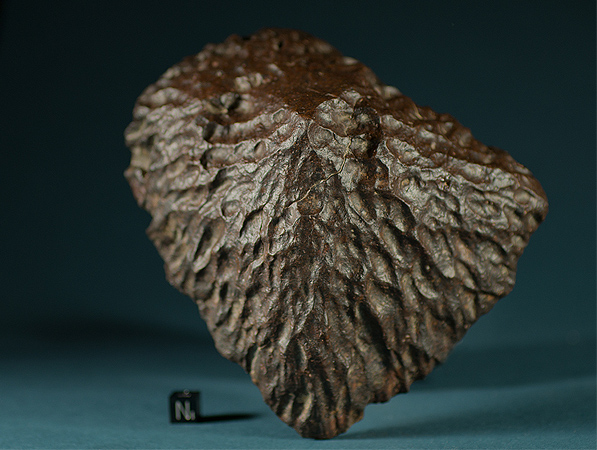
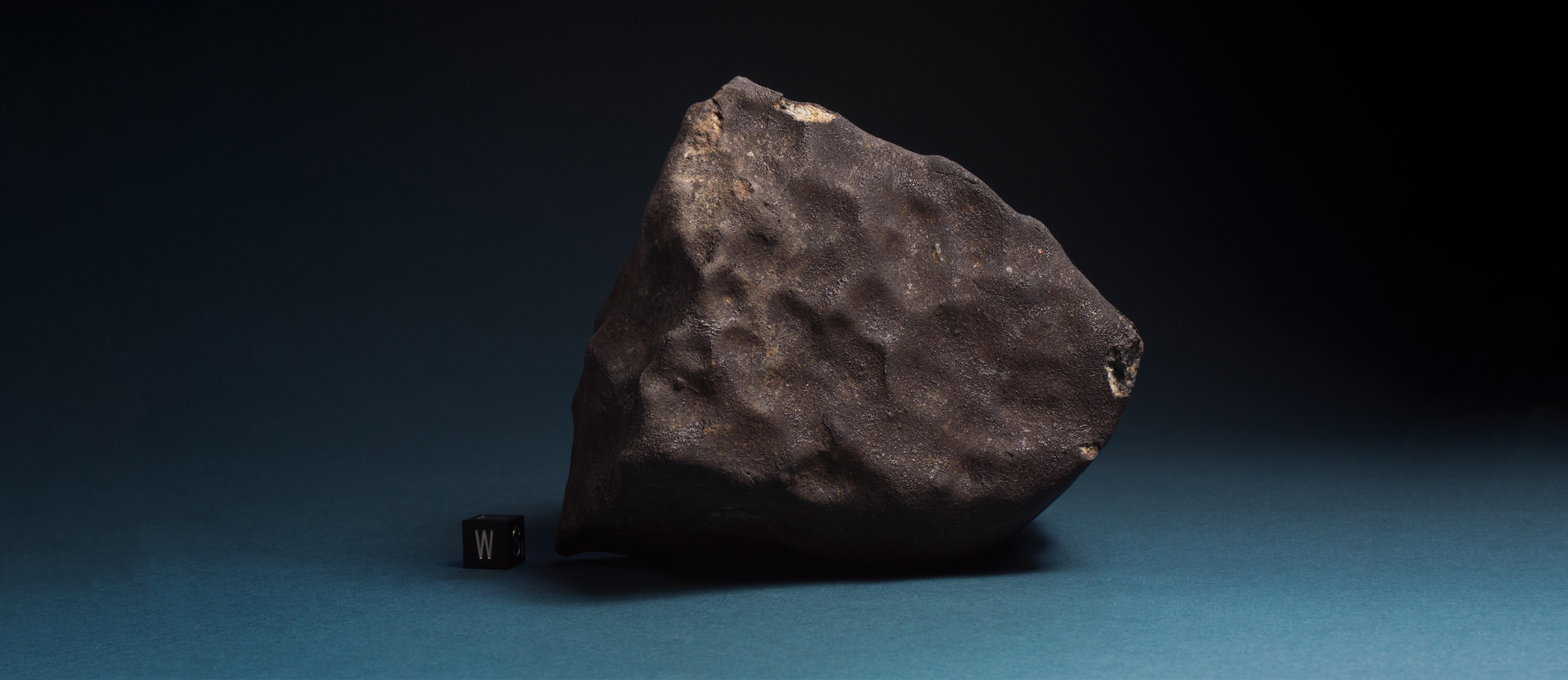
Sheepskin textured 308gm individual.
The meteorite's surface is structured with
irregular button shaped knobs which are intersected by furrow like regmaglypts (cat # 045) |
|
Based on the mass distribution the authors
are quite convinced that at least one mass
larger than the current main mass or alternatively
2 – 3 masses in the 3 - 6kg range remain undiscovered
on the strewn field. The total weight of masses still
undiscovered is estimated to be at least 20%
of the current TKW.
Although the catalog does not give the prices asked
for and paid for individual meteorites the authors
think that market value is another vital aspect that
impacts on the distribution and recovery of the material. Retail
prices at the beginning of the distribution in early
December were 13 - 18 USD/gm for cut slices. When a first
major batch of material became available in February/March
2007 prices fell to 6 USD/gm for individuals and 4 USD/gm
for fragments. Meanwhile some 40kg of material are
circulating in a small and fast saturating market and prices dropped
to 90 Cent/gm in Morocco to 3 USD/gm in Germany and
the US. However Bassikounou meteorites with special
features such as orientation, flow lines, impact marks
or distinct regmaglyption develop along a stable 5 USD/gm.
|

|
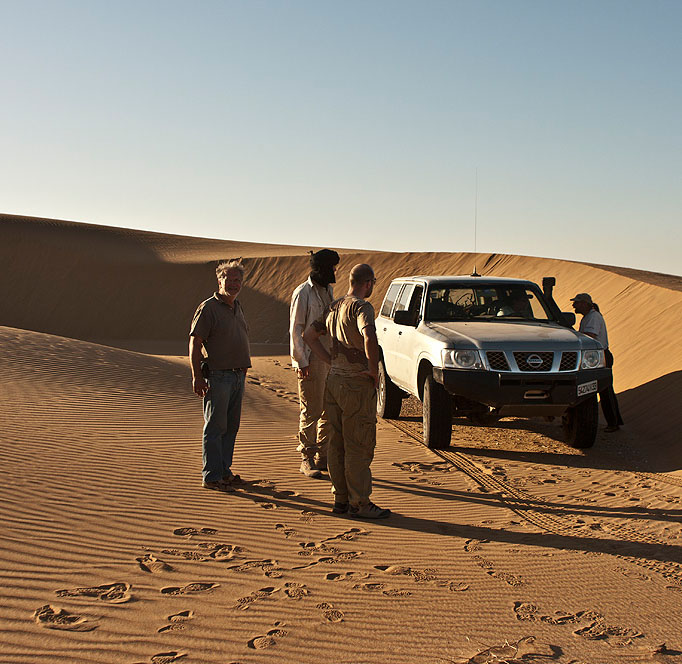
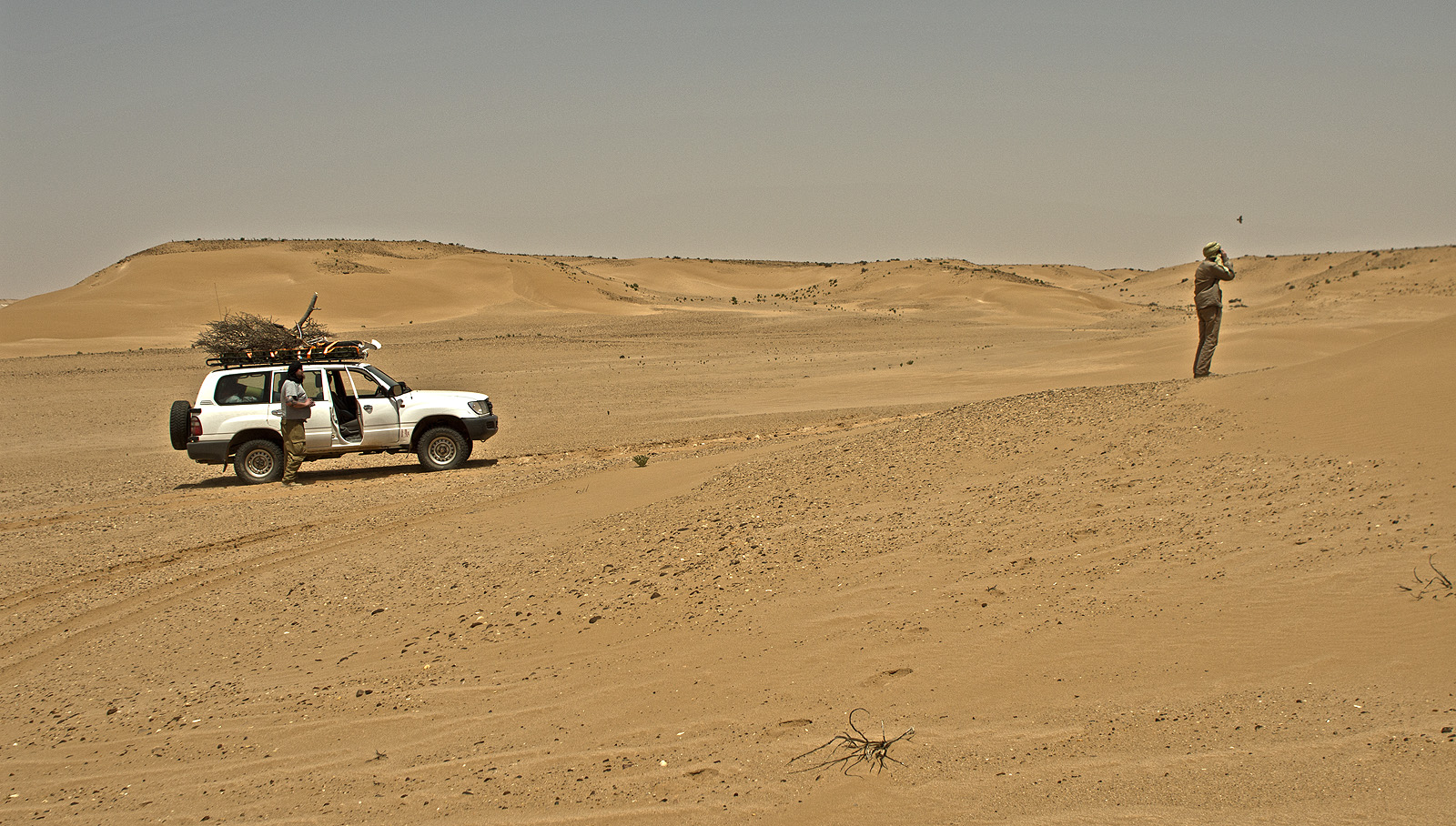
Abdelaziz Alhyane and his series 01 Land Rover.
Supplied by local nomads who prospect on the
strewfields ambitious mineral dealers like Aziz enable
collectors and scientists worldwide to curate desert
meteorites in their collections. It is our obligation
to sensitize these people to value and secure the information
that belongs to the rocks they trade
|
|
With status of mid June 2007 meteorites are still
being found on the
strewn field by the locals and by organized
field expeditions mainly
launched from Morocco. Most of the material found
recently is composed of small individuals and fragments
from the northern part of the
distribution ellipse. The majority of these finds show
moderate oxidation and bright dust staining on the surfaces.
The descriptive catalogue at present describes 108 single masses
of a combined weight of 62.18 kg individually and another 458 single
masses with a combined weight of 31.66kg in lots. At June
30, 2007 the Total known weight (TKW) of the Bassikounou meteorite fall is
93.851kg.
The taxonomic catalogue at present describes 108
single masses of a combined weight of 62.186kg
individually and another 31.665kg in lots. More than
60 individual masses are pictured.
Acknowledgements
The authors are obliged to Dr. Beda Hofmann of
the University of Bern, Switzerland and team for their
diligent analysis of the Bassikounou material. Further
to Hanno Strufe, Germany, for bringing the new material
to the light of the public and for sharing his information
on the find circumstances of the 3.165kg El Moichine mass.
Dieter Heinlein from the European Fireball Network,
Germany, was so kind to advise us on the correct
interpretation of the fireball observations from
Mauretania. With his help the authors were able to
assign a fireball sighting from Adrar in Algeria
to a different event and exclude a connection with
the Bassikounou meteorite.
The authors are especially thankful to Prof. Zelimir Gabelica
and Tomasz Jakubowski for their tireless efforts to contact
French, Belgian and Polish collectors respectively
and to forward data on Bassikounou meteorites that
were already distributed in private and institutional
collections. In Mauretania, we would like to thank our
local correspondent Mohamed Yahya Ould Abdel Wedoud,
Publishing Director of Peace Newspaper, Nouakshott for
collecting eye witness reports on our behalf and for
providing background information on the fall area.
Click the image to access the catalog
click to continue
go to page
1
2 |
3 |
4 | 5 |
Maps & Appendix
|

|