

|
|
|
www.niger-meteorite-recon.de
Kainsaz meteorite expedition
go to page 1 | 2 |
3 |
4 |
5 |
strewnfield map

Arriving at the strewnfield
|

|
Crossroads like this provided little evidence for a firm decision on directions
|
|
After a few kilometers on the road it
soon became clear that the motto of this
trip was “no sleep til Kainsaz”. Pot holes that
should have rather been bridged than filled, gigantic
trucks that high speed approached us with no light
or road blocks with grim Omon troopers pointing their
Bizon submachine guns at us and briskly demanding
ID cards provided the frequent
entertainment that kept me from falling asleep. When Andrew
took over to drive we had the additional thrill that he had
left his drivers license in St. Petersburg. He had driven
the Lada all the way from Moscow to Samara for a 1000 km
before a highway patrol had stopped him in a
routine control and he discovered he was without it.
|

|
The answer to the question if this place had a toilet was ambiguous: "theoriticisci da, practicisci njet!"
|
|
For the whole trip I remember having seen only a handful of
road signs, anyway they were of no assist
to my navigation job due to my limited knowledge of
the Cyrillic alphabet. Talk about roads in Tartarstan,
there simply aren’t any. At least not in our sense of
the word. Later when we left the broad piste dubbed
“Rollbahn” I understood why this country provided an
unsurmountable challenge to all its agressors.
The only armies that ever succeeded in conquering
this terrain came on horseback. Volga Bulgaria,
as Tartastan was named until the 18th century, fell
to the armies of the Mongol prince Batu Khan in the
late 1230s. The inhabitants, mixing with the Golden
Horde's Turco-Mongolian, Kipchak-speaking troops and
settlers, became known as the "Volga Tatars." In the
1430s the region again became independent as the base
of the Khanate of Kazan, Kazan having been founded close
to the ruined capital of the Bulgars.
Tatarstan was conquered by the troops of Tsar Ivan
IV the Terrible in the 1550s, with Kazan being taken
in 1552. Some Tatars were forcibly converted to Christianity
and cathedrals were built in Kazan. By 1593 all mosques in
the area were destroyed. The Russian government forbade the
construction of mosques, a prohibition that was not lifted
until the 18th century by Catherine II. The first mosque to
be rebuilt under Catherine's auspices was constructed in 1766-1770.
|

|
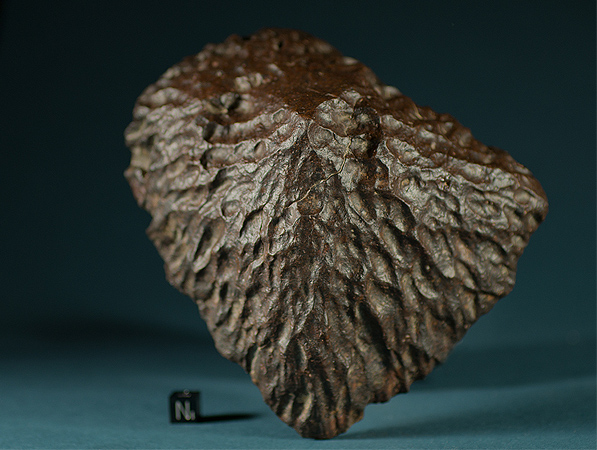
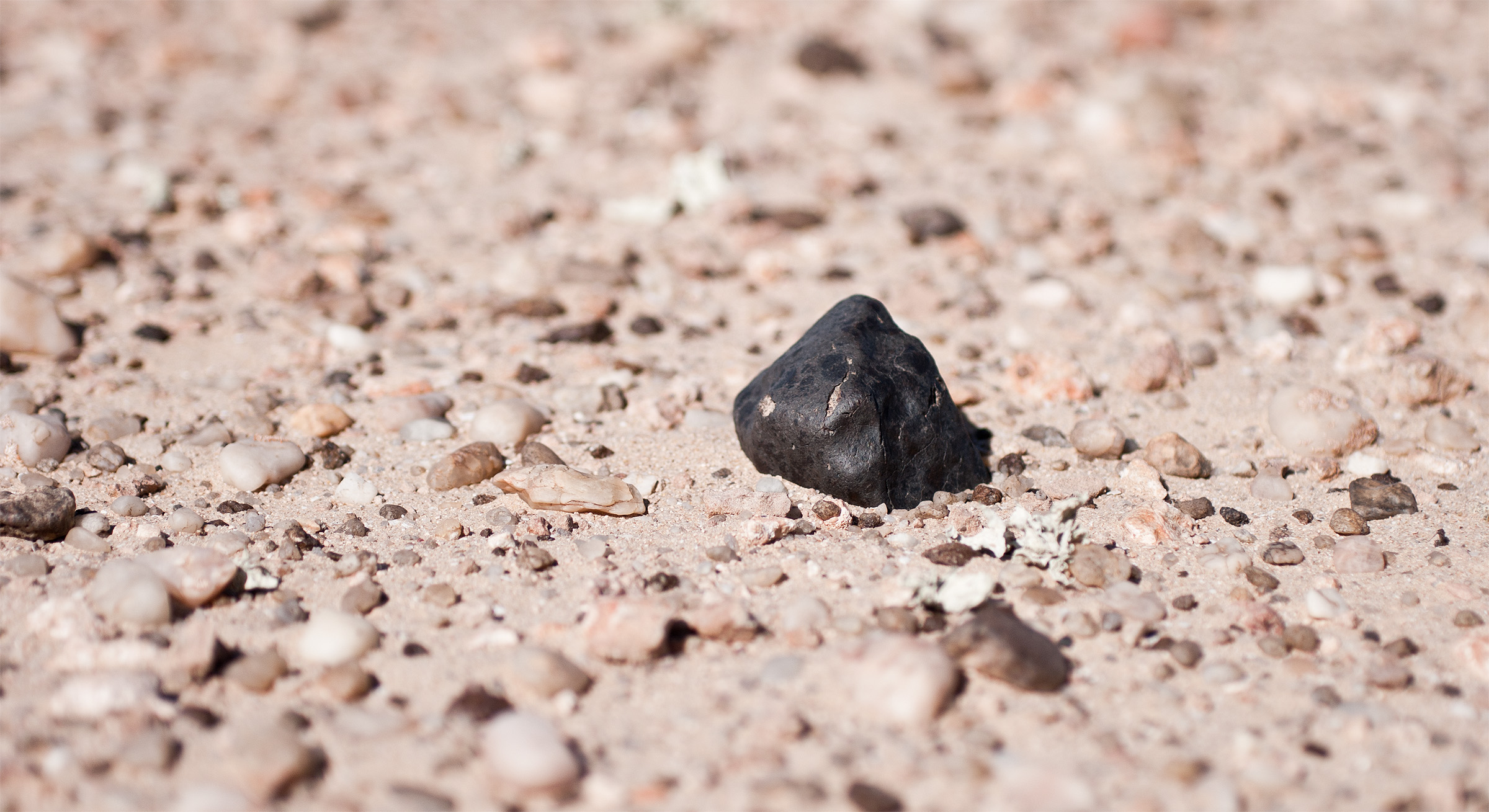
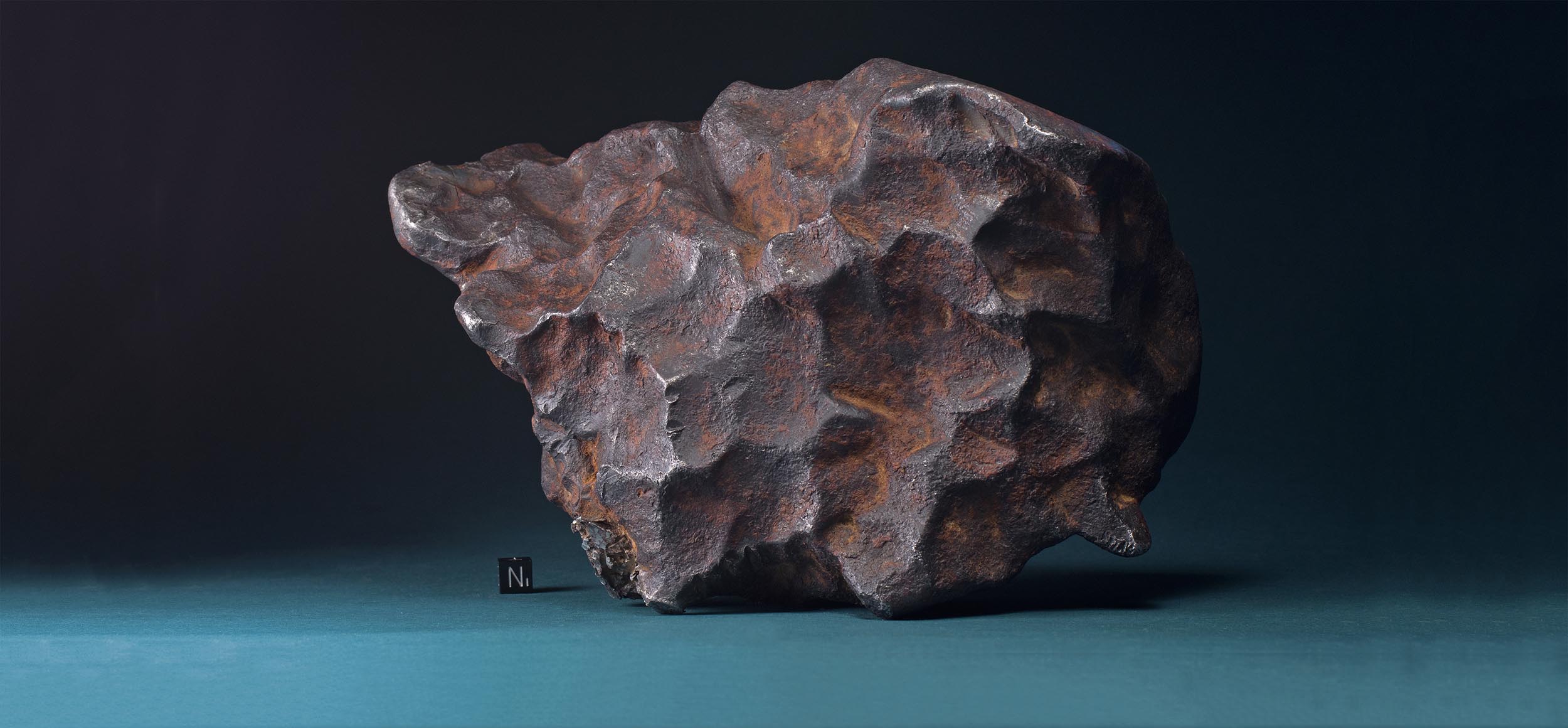
An oriented 73.1 gm Kainsaz individual found in 2000 by a Russian field team.
By visual appearance the recent finds can hardly be distinguished from those recovered in 1937.
In daylight the crust shows a dull black with no signs of oxidation. The
specimen above is photographed under halogen light to highlight the delicate flow patterns
|
|
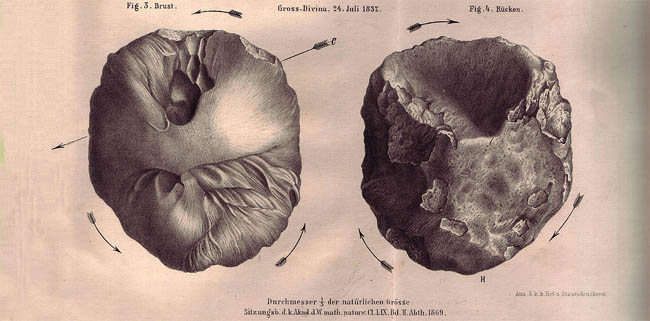
Sept. 13th, 1937, 14:15 hrs, 900 m southeast the Kainsaz collective farm
23 year old Anna Rashkulikhova was working on a
field 900 meters southeast of Kainsaz on the afternoon
of Spetember 13th, 1937. Without any warning all of
a sudden hell broke loose on her. With an infernal
noise like metal scratching against metal the ground
was torn open 5 meters away from her sending a fountain
of soil in the air while a hot shockwave instaneoulsly
sent her to ground ground.
Five or six explosions followed while the
sound of hail falling to the ground continued. Deaf
and traumatized she lay there quivering as she was
trying to realize what just had happened. The dust
cloud of the impact could still be seen when other
workers from a field nearby came to help her. Though
no smoke could be seen in the sky. Two days later
when Anna Rashkulikhova still suffered from a tinnitus
she would report that she was convinced a biplane
had crashed on her. After the other workers had found
her a black 54 kg rock was dug out from a two feet
deep impact pit.
|

|
The beautifully preserved 102.5 kg main mass of Kainsaz today
is one of the centerpieces of the meteorite collection in the
Fersman Mineralogical Museum in Moscow
|
|
After 6 hours and some 120 kilometers later the rising sun
enlightened a pristine heathland and hillmoor scenery only
disturbed by a bundle of gas and crude oil pipelines that
disappeared towards the misty horizon. The gently undulating
plain was intersected by meandering chains of Balkas - this is
how the locals name the narrow but deep canyons carved in the
fertile loess soil by streams of melt water. Their eastern
flanks preserved single islands of pale grey snow that told
the story of a long and grim winter. Gray herons and black
storks stalked along the banks prowling for an early fish.
A beautiful place. But we were lost. The dustroad that we
kept following for the last one and a half hour ended in a
swamp where the map showed a 2nd category highway. The
tracks simply disappeared beyond the surface. Literally
a sunken road.
While scouting back our way to civilization we came
across a couple of industry ruins, half conquered
by the rampantly vegetation. In Russia these are
unmistakable signs of an urban complex in the opposite
direction. As space is to abound in this country, factories,
train stations, warehouses, apartment buildings are never
maintained, restored or pulled down. Instead all these
buildings are rebuilt beside the rotten ones. This way
a city moves on into the open generation for generation
leaving behind a belt of ruins and decay that can stretch
for miles.
|

|
Northern tip of the elliptical strewnfield with the village of Kainsaz
with distribution of the four largest masses. Scale is approx. 1:50000
|
|
We passed through Krabash then through Aznakayevo,
another satellite town until we reached the open
plain again. After overcoming the top of a hill
chain a most exciting view opened. Undulating
grassland stretched as far as the eye could see.
The sharp wind ran silvery waves over the brittle
pasture and in the broad valley below us a horseman
standing upright in the saddle was chasing his Tartar
bronco across the plain in full gallop leaving behind
clouds of steam that slowly faded in the now powerful
spring sun. The screams of a red kite that soared the crystal
clear morning sky in winding circles added to the archaic scenery.
By ten in the morning we had reached the small
settlement of Muslyumovo. We parked our car in
the shadow of the obligatory Lenin statue and Pyotr
entered the local municipal police station to get
his guest registered according to the requirements
of my visa. Together with Andrew I waited outside
and soon after Pyotr disappeared with my passport in
the den a shouting voice was heard that Andrew
translated “Go to hell with your tourist friend
and register him there”. We had no intentions to
do any more traveling this morning so we continued
our mission without official acknowledgement.
|

|
House in Muslyumovo with traditional colour scheme
|
|
Next stop was a grocery shop to collect
the supplies necessary to equip our kitchen
for the two week stay in the woods. While
the others did our provisions I had the opportunity
to study local customs. There seemed to be an obligatory
dresscode. All gentlemen were wearing fur coats or goat
leather jackets, parachute silk made jogging trousers
in screaming colors and rubber boots. Not so the
mostly noteworthyly beautiful women. Dressed in elegant
costumes of the latest Paris fashion, tight jeans or
tailor made suits they gently stepped along the
dustroads of the village in debonair tights and
Italian high heels as if this was a normal day
on the Milano catwalk. This is the land of
supermodels and drunken men in fur coats I thought.
I joined the others in the shop to find
Pyotr caught in intense negotiations
about a frying pan. Andrew translated:
“I doubt that this pan will be suitable to
fry on a kerosine stove or an open fire, it
is not worth your high price”. The shop keeper
replied: “Of course it is my friend, I just had
my breakfast made in it and I can assure you it
fries great.” With an almost new red star brand
frying pan and 150 more or less carefully packed
eggs we left the shop and continued along the
green banks of the Millya river towards our destination,
the Kainsaz meteorite strewnfield.
click to continue
go to page 1 | 2 |
3 |
4 |
5 |
strewnfield map
|

|