

|
|
|
|
www.meteorite-recon.com
Saquia al Hamra Meteorites
Page
1 |
2 |
3 |
4 |
5 |
6 |
7 |
8 |
9

Saquia al Hamra - Meteorites of the Western Sahara. By Svend Buhl
The Douk-Douk
The next morning we got up a little later than usual. Marc and I were enjoying an
extended breakfast, when suddenly a strange figure staggered into our field of view.
The apparition turned out as Roger's tent, including its hooded owner. Apparently part
of the mechanism jammed and could only be repaired by complicated movements brought
to effect from within the structure. With interest Marc and I followed the presentation.
The two legs projecting from the peaked and dancing superstructure reminded me
of an exotic picture. At first it didn't come into my mind of exactly what the Swiss Dances with Tents reminded
me. It was not until an accidental glance at Marc's
breakfast knife sticking in the bread before me that the scales fell from my eyes.
It was a jack-knife of French colonial times, and in its steel handle a Douk-Douk
was engraved. The dancing medicine man from Papua New Guinea in his cone-shaped
bast costume bore a remarkable resemblance to the performance displayed before us.
|

|
A mechanical or a spiritual problem, one didn't know
|
|
|

|
Engraving of the Douk-Douk
|
|
After the Douk-Douk had successfully completed its incantations we
were ready to depart for the day's work. And as if his
anecdote of the previous night needed another practical demonstration,
Pjotr was already about to prepare for the next strike.
Before we would continue our search, we had planned to drive to El Aaiún in order
to resupply with diesel, water and food. Because one way was about 140 kilometers
we would transit the Dayet Hamada without spending time for closer searching. Unfortunately,
we didn't get that far. We had just climbed the slope and rolled less than a minute on
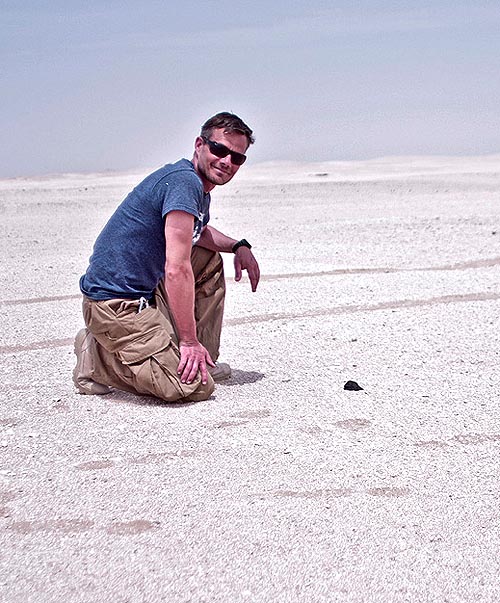
the plateau when Pjotr called out "stop!" and I hit the brakes. Without a comment he got
out of the car, walked a few steps and calmly announced that he had found another meteorite.
This was creepy. I joined him disbelievingly and bent down to his find. And indeed, Pjotr had
just found the second
meteorite of the trip. And that, not even 800 yards from the site of the previous day's find.
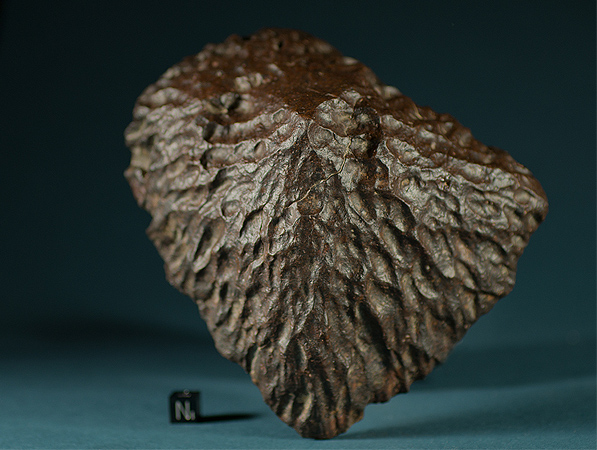
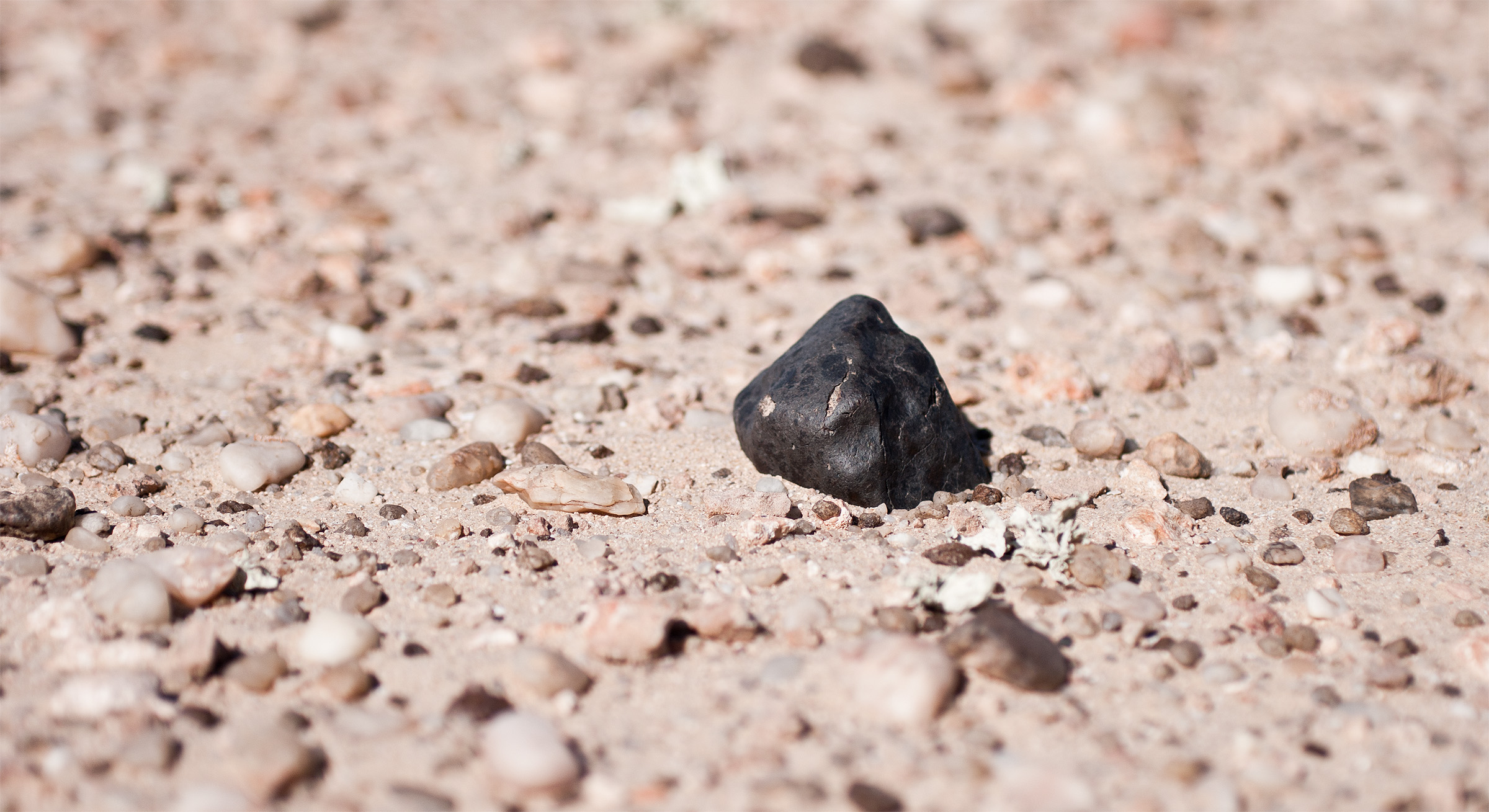
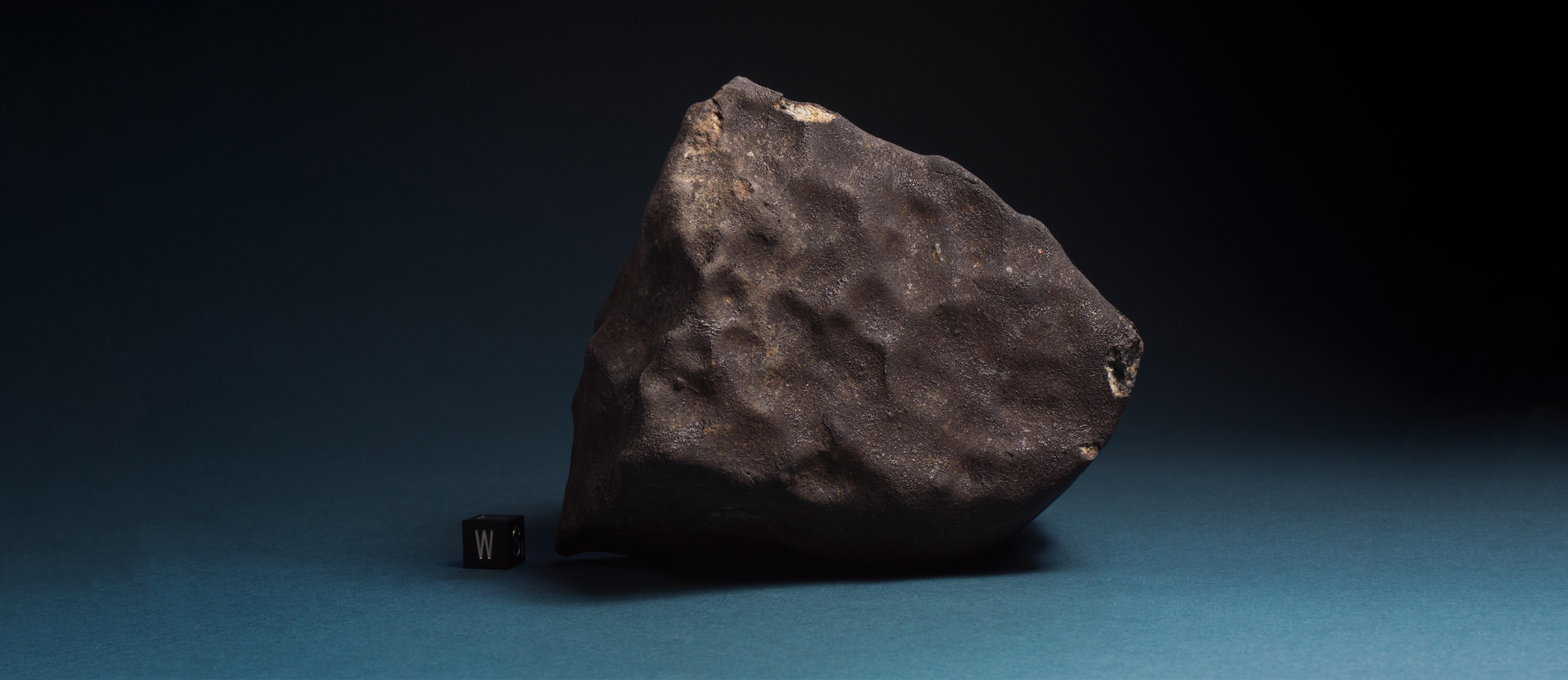
The small rock was not easy to recognize as a meteorite. Not even
if one stood directly before it. Its chestnut colored surface only
differed about nuances from the surrounding sandstone pebbles. The 38
g meteorite, an ordinary chondrite, showed moderate signs of weathering
which spoke for an already considerable terrestrial lifespan. A progressed
smoothing of the formerly velvet textured fusion crust as well as a matte
shimmering patina suggested a fall event in prehistoric times. Anyway, it was
a complete individual with beautifully curved edges, and definitively not
paired with yesterday's achondrite finds.
There was nothing particularly spectacular about the small inconspicuous
rock, apart from the fact that it came from a 4.5 billion year-old chunk of rock
floating in deep space. But the fact, that this was already the
second find by one and the same person on this so thoroughly searched plain
seemed remarkable to me.
|

|
G'idat Amwizirat 002 (field name)
|
|
We documented the new meteorite find according to our protocol, and
after that we spent another hour to search the closer surroundings on foot.
Later in the afternoon we would return, assign search grids to each
car and comb the plain - again.
The drive to the provincial capital El Aaiún passed uneventful.
Approximately forty kilometers south-west of our camp ran the asphalt
road Smara-El Aaiún. It took us less than an hour to reach the chain
of telephone poles running parallel to the road. On our way we passed
along the endless conveyor belt transporting the phosphate mined at Bou
Craa to the port of El Aaiún. Its strategic importance to the region
was underlined by the numerous military compounds, emplacements and radio
masts along its course.
Following our arrival in the city we stocked up on fresh
supplies at the local general store. After a hearty lunch and
a brief stop at the gas station we hit the road again. On our
way back into the desert we met a lonesome walker trudging
under the merciless midday sun on the desolate road towards
the city. Upon our question, if he needed help he laughed and
asked for a cigarette. With a box of smokes, two bottles of water,
a bag of canned tuna he very happily continued along his path.
Shortly before reaching a little hamlet we passed a giant heap of
concertina wire which was piled up beside the road with the evident
purpose of catching the abundantly flying plastic bags and impaling them on
its rusty barbs. The hamlet with the well-known name of Itqiy consisted of a
not so very inviting snack bar and several trash filled shags and bunkers. We passed
through and half an hour later our little convoy turned off the road and back
onto the Hamada again.
|

|
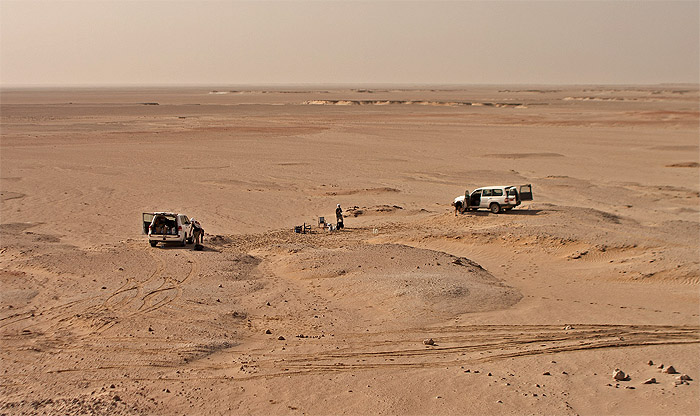
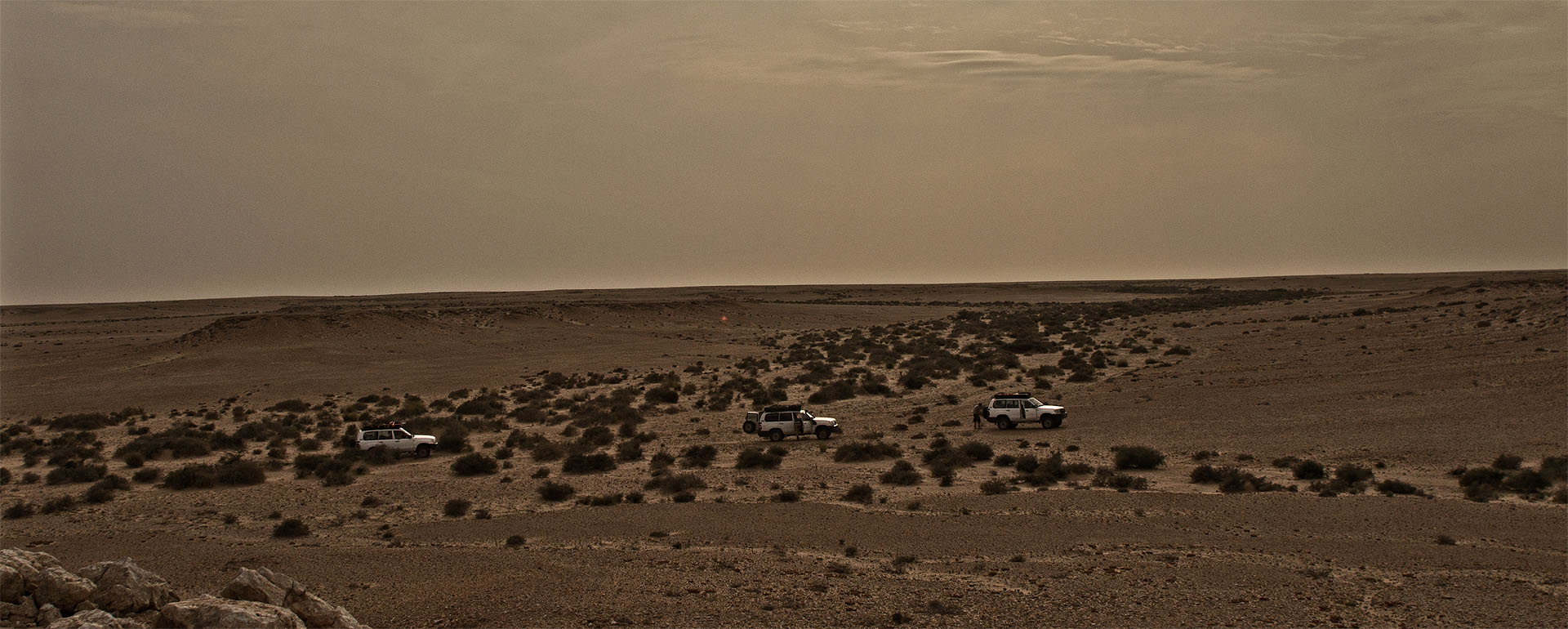
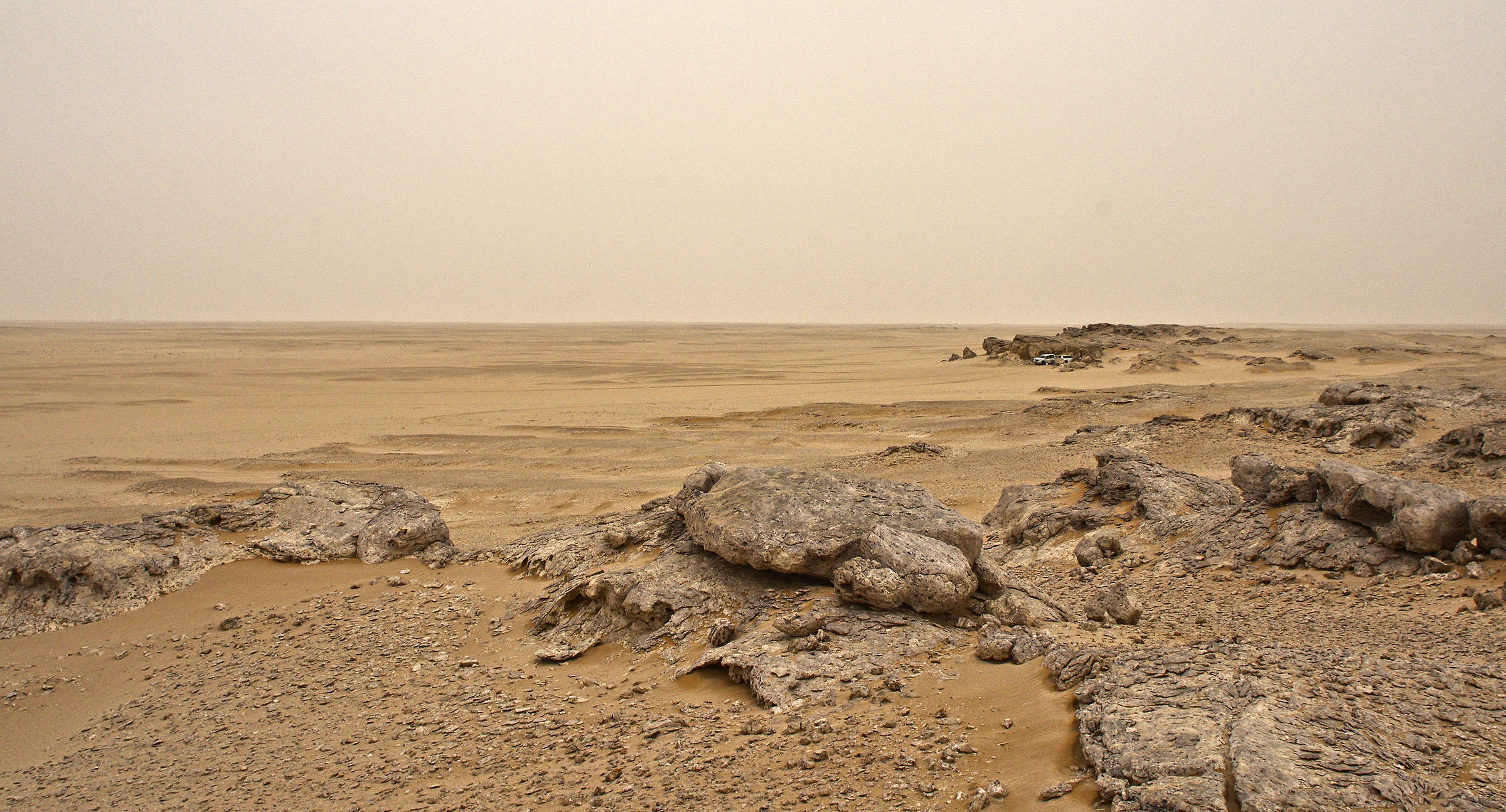
Dayet Hammada, view to the north across the tributaries of Wadi Tighzert
|
|
Six kilometers ahead of the achondrite find site we parted and each team
started to work on its respective search grid. Until dusk we followed search
tracks contrary to the course of the sun which lead us farther to the northeast.
The fact that we did not find another meteorite this day
did not affect us at all. After all Pjotr had already raised our daily score in
the morning.
Towards the evening at first our Swiss friends were the first to be forced to acknowledge
that compliance with hygiene guidelines during the preparation of the chicken
we had enjoyed in El Aaiún probably had not been taken very seriously. Already
during the night an acute acceleration of digestion occurred, which could not be
controlled even with a heavy dosage of charcoal tablets. In the evening I
still had suggested to exile the Swiss into a quarantine camp on the Hamada and leave them
to their fate. But my wisecracking soon left me when Pjotr and I were affected in the
morning as well.
|

|
Find location of NWA 773 according to the MetBull entry
|
|
There wasn't much we could do about it since we had work to do, even with green
faces and frequent interruptions. Until noon we searched the G'idat Amwizirat up to a
distance of twelve kilometers west and southwest of our find sites. All through the morning we
worked on the flat Hamada. Then we decided to expand our search also into the labyrinthine
maze of canyons and Queds originating from the edge of the plateau and
leading north to the lower Qued of the Saquia.
Soon the descent, which was rather an uncontrolled slide, down the
forty yard steep slope demanded utmost concentration. Our progress
north along narrow ridges and across fields of razor-sharp flint debris was slow and exhausting. Repeatedly we traversed meter deep gullies.
Because they were located not far from our course we had chosen the find
coordinates of NWA 733 as a reference and meeting point. In the Meteoritical
Bulletin database this site is described as "a flat dry desert plain". When
we arrived there we had our doubts if the correspondent who submitted this description
had really meant this gully-intersected, rutted valley. Dry it was, indeed,
that much we could confirm.
|

|
Flintstone fields claimed another tire
|
|
The sharp-edged flint had cost us another tire. Already in Smara already, and also later
on the Amwizirat, we had been forced to carry out repairs. To fix the punctures, the
resourceful Swiss applied a poison-green panacea which was injected into the tubeless
tire with the help of the little but powerful compressor we carried. It took Marc half an hour of
work and a couple of tightly driven circles to dispense the
liquid in the tire before we were ready to go again.
In the meantime we walked the surrounding hills which showed impressive outcrops
of radiolarite and plenty of geodes in all sizes weathering out of the limestone
substrata. On the terraced slopes one could study countless partly meter-sized geodes in varying states of
weathering. From the inside of the broken druses white calcite gleamed like hoar frost.
A vehicle-based search in this terrain was by no means practicable. One was happy
to avoid capsizing the car on the steep slopes or to get stranded in one of the
bottomless sand-filled gullies. With serious efforts and after several detours we worked
our way back to the plateau. Late in the afternoon I handed over the driving to Pjotr in
order to walk the last five kilometers to the find site which lay exactly north by
northeast of our position. I left the GPS in the car, as the low
standing sun in my back would be sufficient to keep direction. All I had to do was to simply follow my shadow.
Zigzagging to cover as much surface as possible I marched towards the northeast
across the windy Hamada. The exercise was pleasant, but on my walk I came across
no suspicious stone whatsoever. After a little more than an hour I reached my
destination. Despite the improvised navigation I missed the small stone pyramid, by
which the find site was marked, by only hundred
yards. It was good to know that in an emergency situation old school navigation
was quite sufficient to get one through this terrain devoid of any landmarks.
|

|
Pre-Islamic grave mound, G'idat Amwizirat
|
|
None of us had found meteorites that day and it seemed as if, apart from Pjotr's two
solitary finds, there would be nothing more to celebrate on this expedition. That
night everyone went early for a much needed rest since our intestinal flora, which had been
ruined completely on occasion
of our visit to Sidi Ali's Chicken Roastery, still took its toll.
|

|
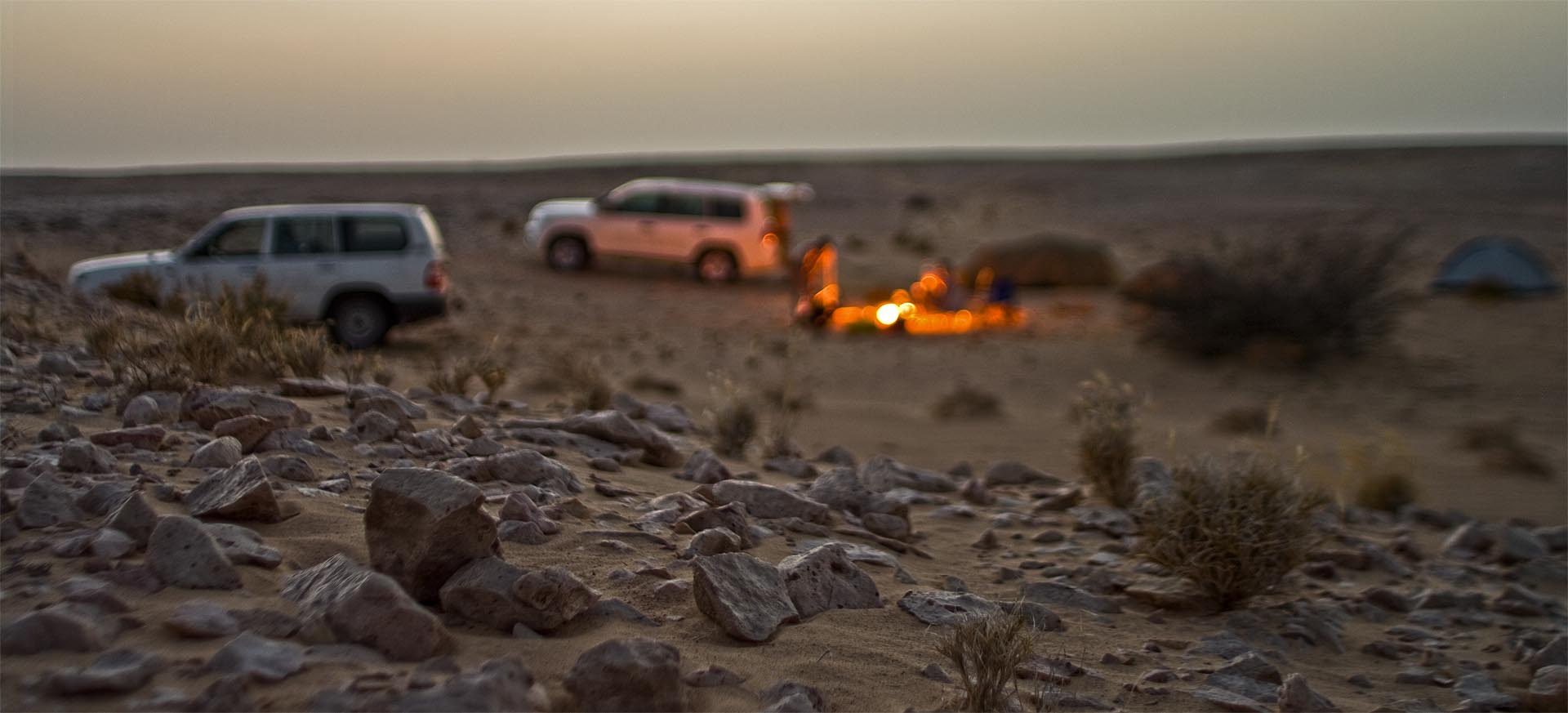
The tree-day camp close to the find location of the G'idat Amwizirat 001 eucrite, night photo
|
|
In a semi-somnolent state I overheard Roger and Pjotr rivaling about who was chasing the biggest
scorpion. The only thing which worried me was the fact that their competition appeared
to repeatedly focus around my tent. The next morning the two presented me their photos.
As Roger put it, they had 'in situ documented', what obviously were full-grown specimens
of the fat-tailed scorpion Androctonus, the "man killer", as the literal translation derived from the Greek means.
Only after our return did I learn from the
relevant sources that the species of this genus were among the most toxic specimens
which the complete order had to offer. Notably A.
liouvillei reportedly seems to deliver an extremely unpleasant neurotoxin.
|

|
After nightfall our camp was swarming with fat-tailed scorpions. Pictured is the nocturnal predator
Androctonus liouvillei which is considered among the most dangerous scorpion species known
|
|
The next morning, it was our third day on the Amwizirat, we decided to abandon the
fruitless search for other masses of the achondrite. Fortunately there was no
shortage of alternative targets. On the satellite chart I pointed out a small
plateau framed by steep canyons on the southern edge of the Saquia valley. Since
our topographic map lacked field and place names for many areas, I had assigned
letters of the alphabet to preselected reference points. The plateau in question,
which was part of the Grart Nwissiat as we later learned,
was marked with the letter "Z". Henceforth we spoke of it as the Zulu-plateau. It was
declared our new target.
The place seemed to exert an unusual attraction on us. Already during our
first day on the Amwizirat we had tried to find a passage through the ravines
to take us there, but we had turned back in the face of endless flint
fields without having achieved anything apart from a punctured tire. This day,
however, we were hell-bent on reaching Zulu plateau. On hairpin tracks along narrow ridges and through Queds
often blocked by drift sand we advanced towards our destination.
continue
Page
1 |
2 |
3 |
4 |
5 |
6 |
7 |
8 |
9
|
© 2001-2010 Meteorite Recon
|
|