

www.niger-meteorite-recon.de
Rub' al-Khali Expedition 2008
page 1 | 2 | 3 | 4 | 5 | 6 | 7 | 8 | 9


Text: Svend Buhl, Photos: Svend Buhl and Thomas Kurtz

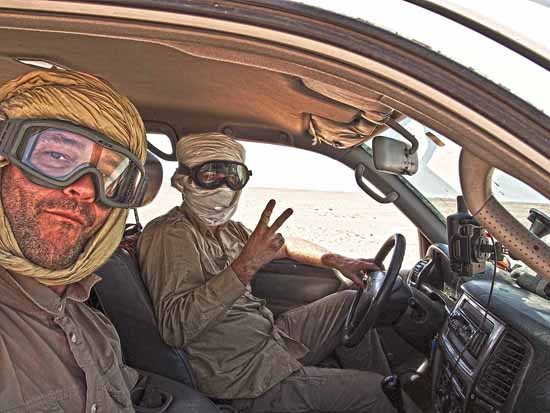
The following day promised to get considerably hot. When we started at sunrise, the outside thermometer of our Land Cruiser already displayed 68°F. We were innocuously unconcerned about this because although our subjective heat sensation constantly rose during the following hours the green digital display still claimed the temperature had settled at a constant 68°F ('Man, these 68° start to feel pretty combustive'). As the sun climbed at its zenith the two of us had already repetitively burned our skin at the scalding hull of the Land Cruiser. When our hygrometer announced that relative humidity had dropped below eight percent and every step outside the shadow of the car had become an exertion we finally began to doubt the credibility of the small green digits.


Search on foot

And in fact, a short while after we had killed and restarted the engine the thermometer already announced 115°F. This certainly was a closer match to reality. As far as atmospheric humidity was concerned I had never witnessed anything near let alone below fifteen percent so this was quite a new experience. It even dwarfed the dust dry Bordeaux wine from the previous night.

The many flies that had plagued us the past days and that penetrated into trousers, nose, eyes and ears and that could not even be scared off the fork one lifted to the mouth were all abruptly gone. The billowing desert floor that we rolled on the coming days from now on was flecked with dead moths, locusts and hymenoptera. A couple of days later bird carcasses joined them.

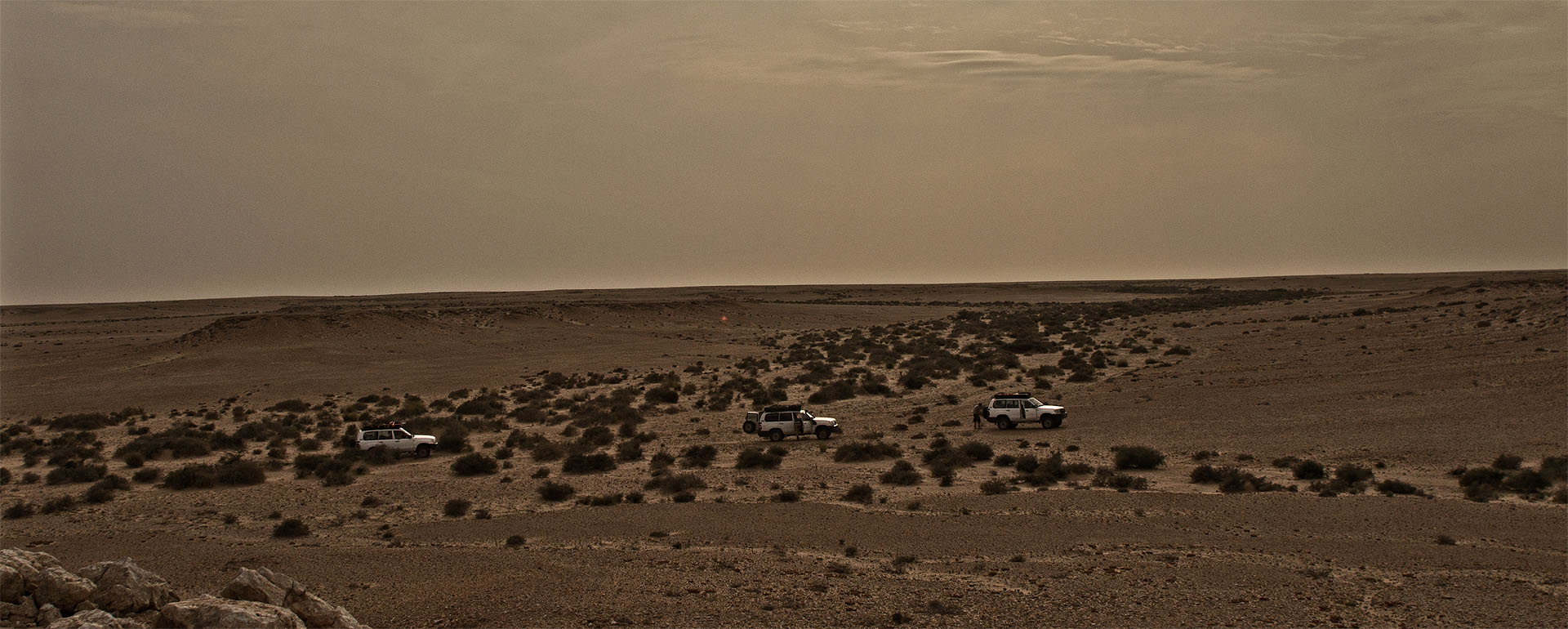
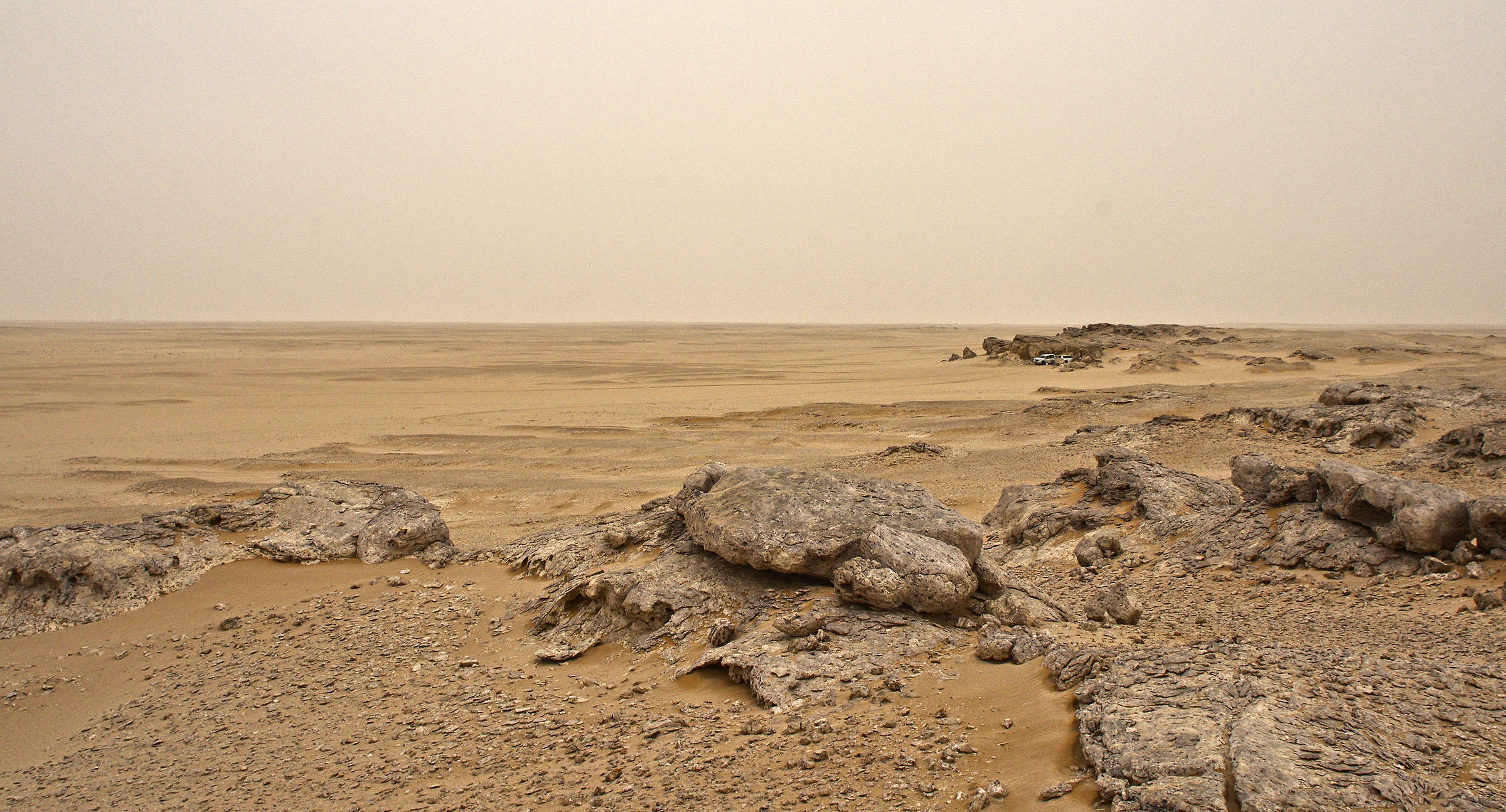
At noon we scaled a limestone butte in the prospect of some gentle breeze. We parked over a shallow erosion ditch on the top that provided enough space below the chassis to drowse in the shadow. The plan was to catch a nap until the desert would return to more favorable conditions for endothermic life forms. For the first time I experienced a kind of heat that seemed physically exhausting while simply sitting in the shade. Thomas appeared groggy as well. Though he determinedly rejected my allusion that the way he lingered below the car suggested a first resemblance to the bloated camel at the roadside.

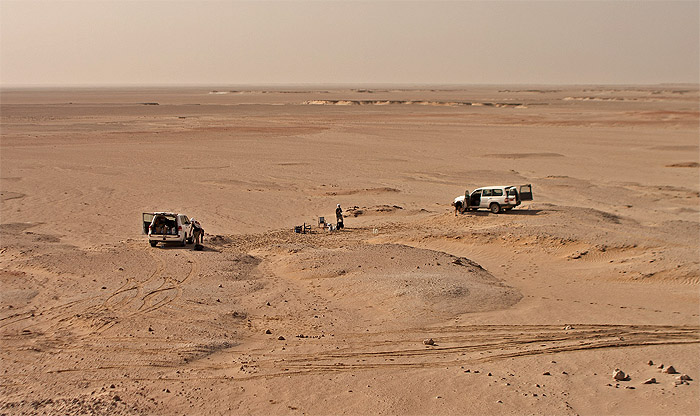
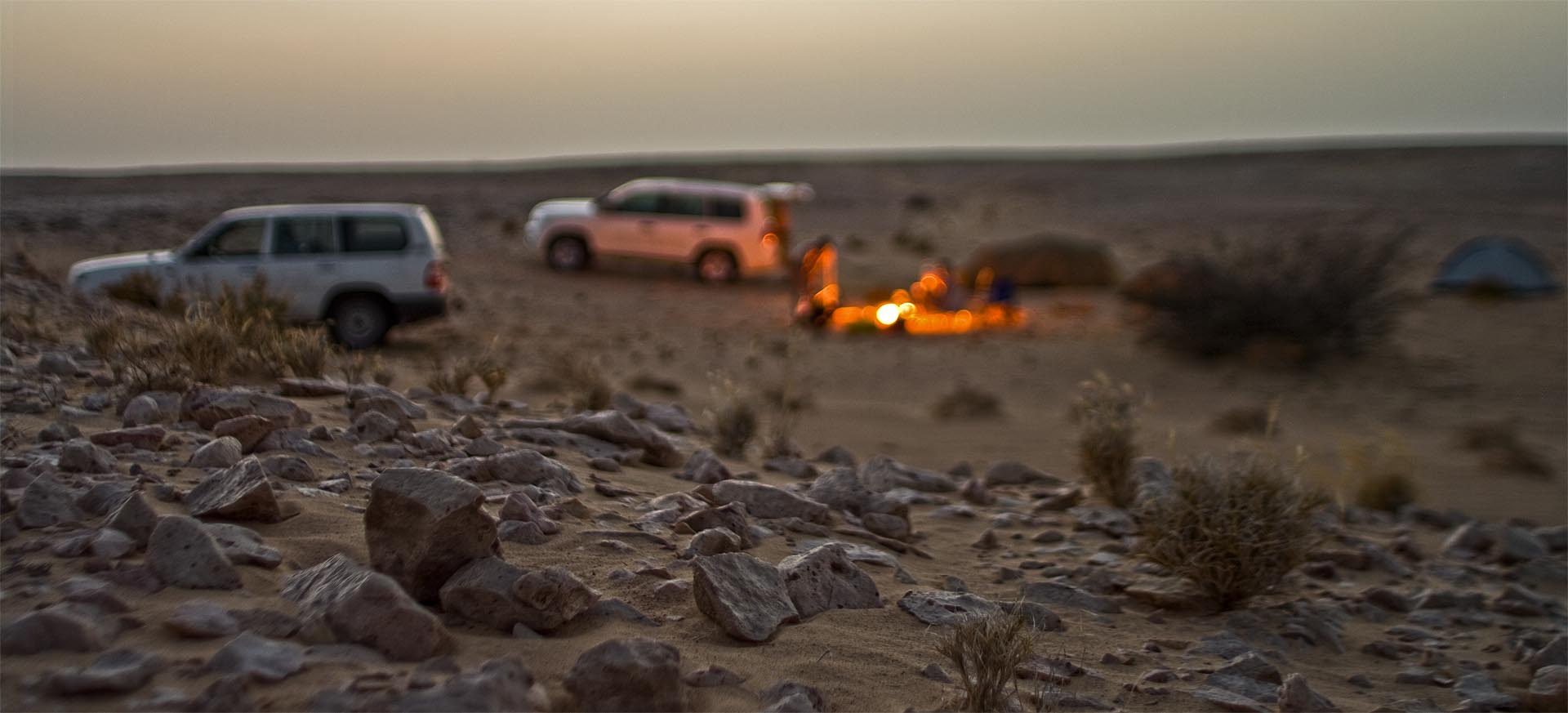
It was not until 03:00 p.m. that we continued searching that day. But despite the good visibility and the vast stretches of untouched land free of tracks and other signs of human presence we did not make another find. In the late afternoon we halted to collect some firewood for the night. More precisely, we dug out the abundant roots of Shakr bushes that must have died a long time ago. They burned a lot better than dry camel dung and besides they were to be preferred to the latter at any rate because of their aromatic odor.


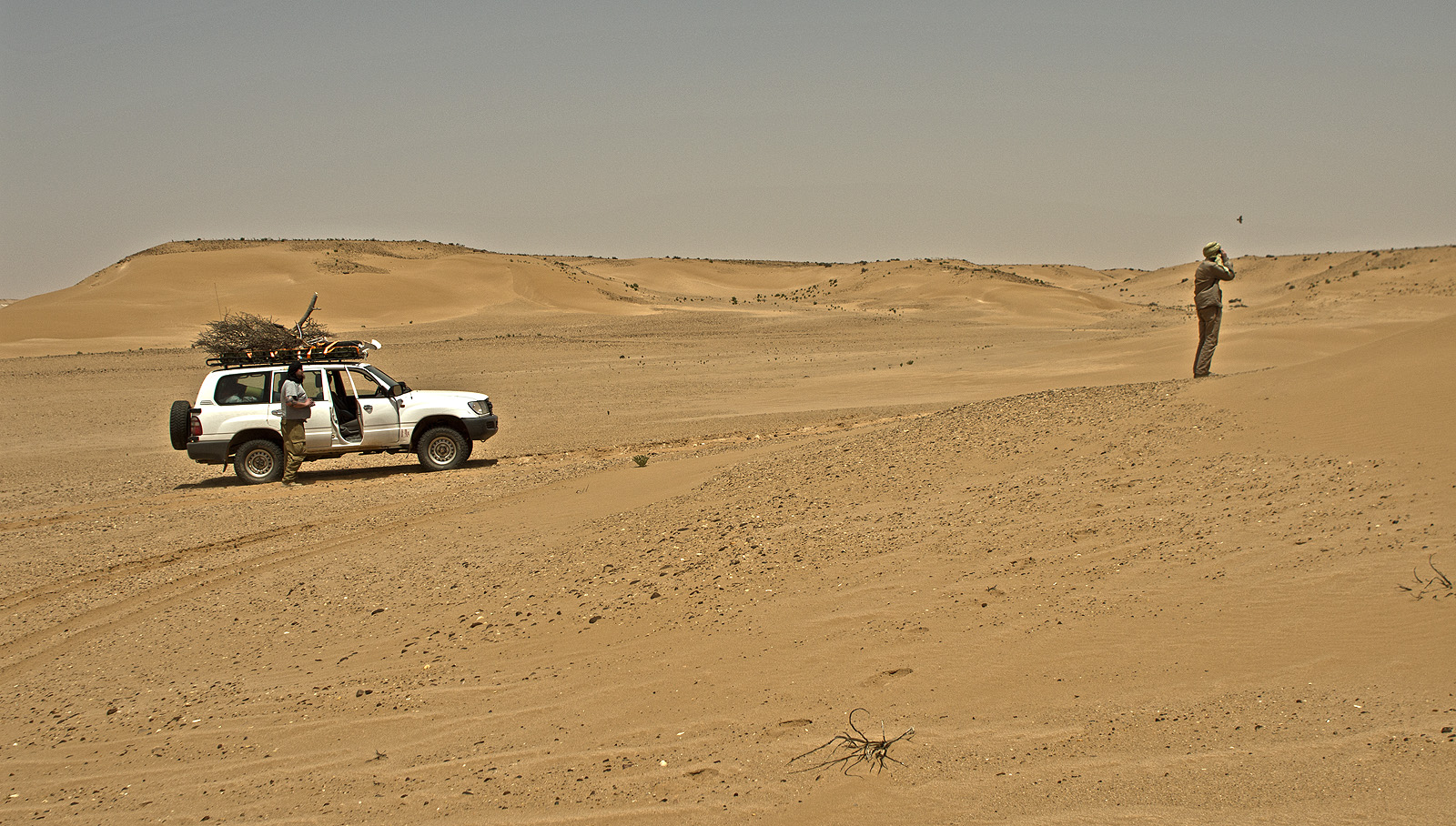
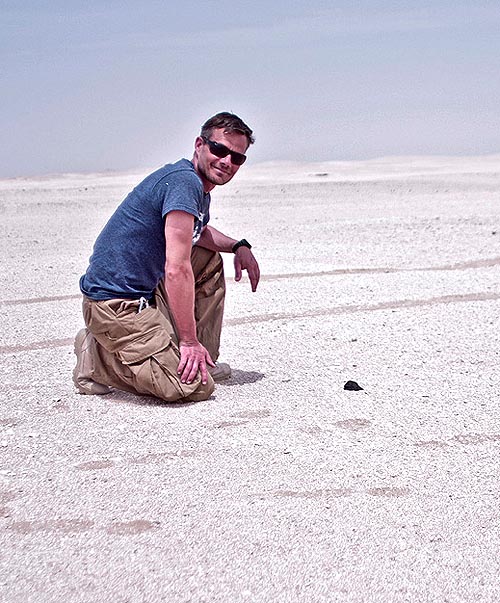
The distance from the photographer to the author and the 90g meteorite at his feet is 85 meters. It was the first find we made by bridging the working distance of the human eye with the Hensoldt field glass.

While pitching my tent I discovered a torn out and missing eyelet. Unfortunately the component was indispensable for the construction because it served as a bearing to the fiberglass poles of the frame. Out of a ring pull from a sardine can I fabricated a full-fledged replacement which led Thomas to the comment, this 'outspeeded even MacGyver'. I understood the hint and also riveted Thomas's camping chair. This particular piece of equipment looked as if it had seen action in several of Rommel's Africa campaigns. As a seating accommodation it was only of limited use.

In return I benefited from my companion's excellent knowledge of star constellations. He showed me a number of stars and nebulae hitherto unfamiliar to me. Among them Canopus in the constellation of Argo Navis, today better known as Carina. Named after the pilot of Menelaus on his quest to retrieve Helen of Troy, Canopus is the second brightest object in the night-time sky after Sirius. I had noticed the star already at the previous evening and couldn't figure where to assign it to. 'No wonder' according to Thomas: Canopus was so far south in the sky, it never rose in mid- or far-northern latitudes and could not be seen north of latitude 38°N. It was only when he mentioned the star's Arabic name 'Suhael' that I remembered my guides in Niger had navigated by it.


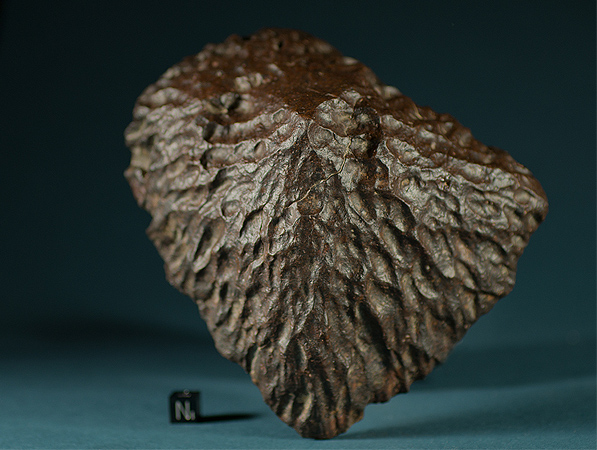
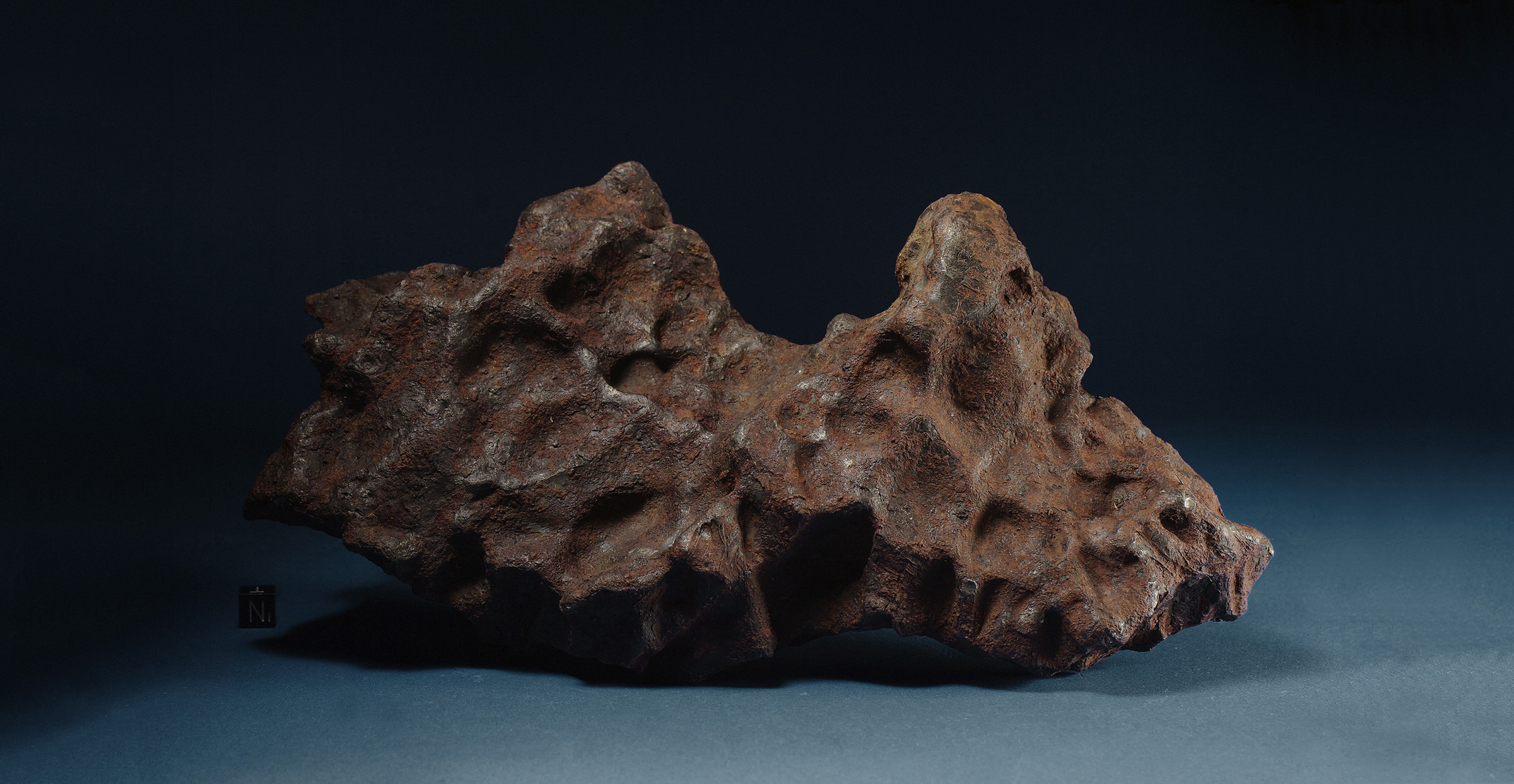
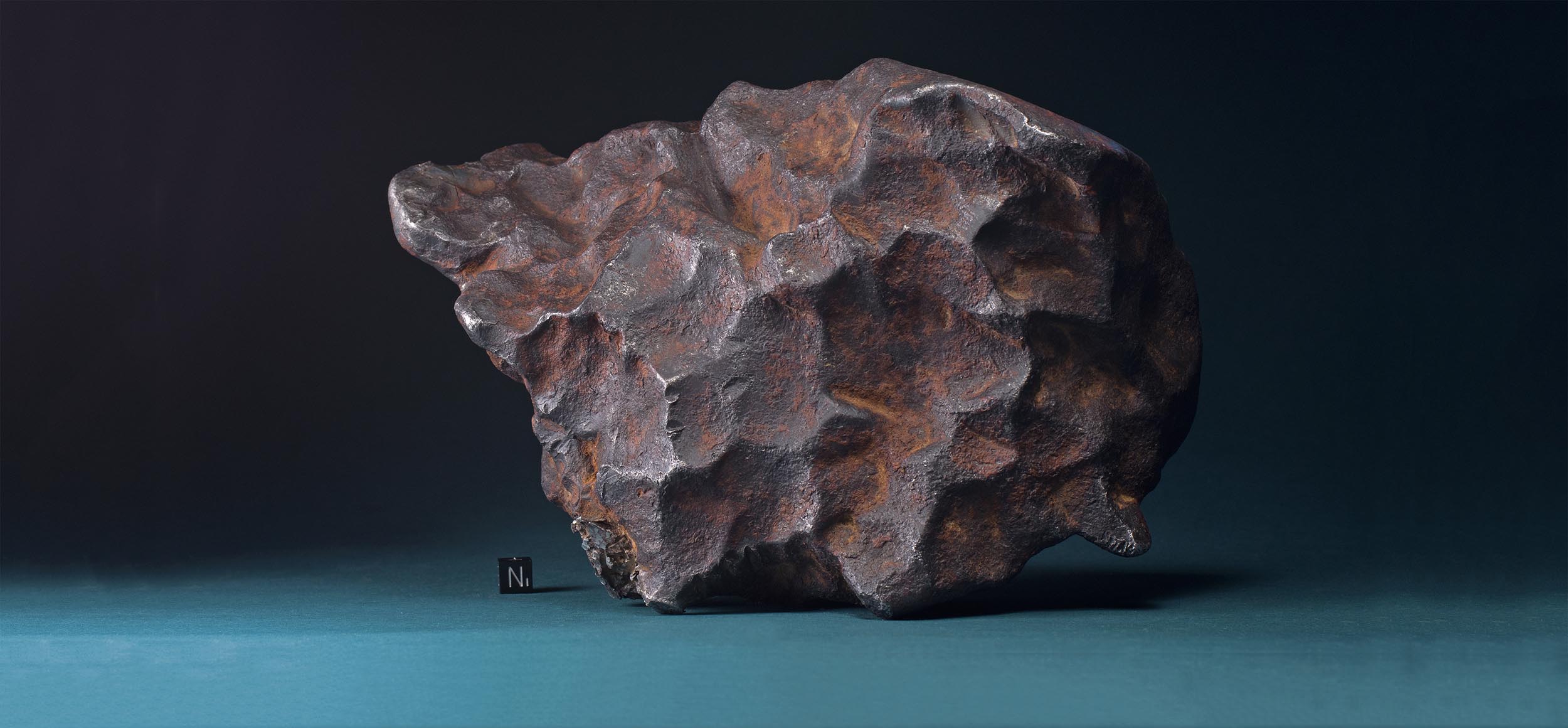
'Rub' al-Khali 007' (field name), an ordinary chondrite of 90.20g


'Rub' al-Khali 007'
I had been told there even were few among the old caravan leaders who will always lay down face towards Canopus at full moon nights. 'And why is that?' Thomas inquired. I wasn't quite sure whether the legend of the ghost caravan would be a bit too much of strong meat for my brave companion. On the other hand the story might dispel his thoughts on decomposing carcasses…

The ghost caravan

'The camels would scent them first', I began. 'They will start snorting and try to get rid of the bonds the Bedu tie their legs together with at night. The wind dies and a sudden calm creeps across the nightly desert. The first sleepers awake to the uneasiness of their pack animals. Then, only subtly, the sand begins to oscillate. The vibrations intensify and single shadowy patches appear in the twilight, hell-bent pacing towards and by the camp. These are the animals of the desert, hyenas, foxes, lizards, curly tangles of insects, all in full panicked flight, away from an unseen source of terror. The caravan springs to arms and stares towards Canopus. And there under its metallic light the first gray specters emerge over the horizon. 'Allah have mercy upon us' murmurs the leader, 'the ghost caravan!'.

Led by diffuse ochre drivers Camel after camel wafts over the horizon. Voluptuous women draped with gold are seating in the high saddles. At their feet slaves and maidens are balancing archaic jars on their heads. They wander soundlessly among the biblical trail. Silently and without casting a shadow the terrible caravan follows its way in the cold moonlight. Without number and for hours as it seems they are wandering by. They say on sight of the caravan the carcasses of the camels buried all over rise from the sands. The bleached bones morph into shadows, their bodies filled by swirling dust. The dust also whirls into the shape of ochre men gripping for their reins. From all sides the perished of the desert join the trail of the ghost caravan. Al those devoured by the sands rise from the dead in this night and join the caravan of revenants. To pray they march towards Mecca. He who is touched by one of the shadowy riders is doomed to join them. Alone the call 'Allah' has the power to protect the traveler. And it is not until the crack of dawn that the phantoms disappear.'

'The ghost caravan is not only an ancient legend', I explain. 'It was seen in N'djamena in Chad in 1995, in the Tibesti in Libya in 1998, near Mopti in Mali in 2005 and close to Al-Faschir in Darfur in 2006, so I have been told.'

While Thomas set up his telescope to check in the direction of Canopus for any unusual occurrences I went in my tent and hit the sack. At sun-up we were already en route.


The author at eye level with a meteorite find ('Rub' al-Khali 004')

Hour for hour we searched a wide flat depression. We checked roots, dead birds, cast shadows, a sandblasted can and the casual odd stone. Every time with decreasing distance the certainty increased that the object again would not reveal itself as a meteorite. Scanning the field of vision with the naked eye was an easy business until early noon. But after 10 o' clock watching into the flickering brightness of the limestone plains was only possible with a good pair of sunglasses.

At about eleven o' clock we reached a narrow eroded chain of hills bordering the plain that we had searched since the morning. I dropped Thomas who preferred to continue on foot, but not without advising him always to maintain visual contact with the vehicle in the confusing terrain. Around noon I was driving a loop about four hundred meters from my companion when left of me a group of dark varnished stones appeared. They differed considerably from the common prehistoric fireplaces abundant in the area. While turning I recognized that I was dealing with a burial site. Several meters to the left was a second grave.


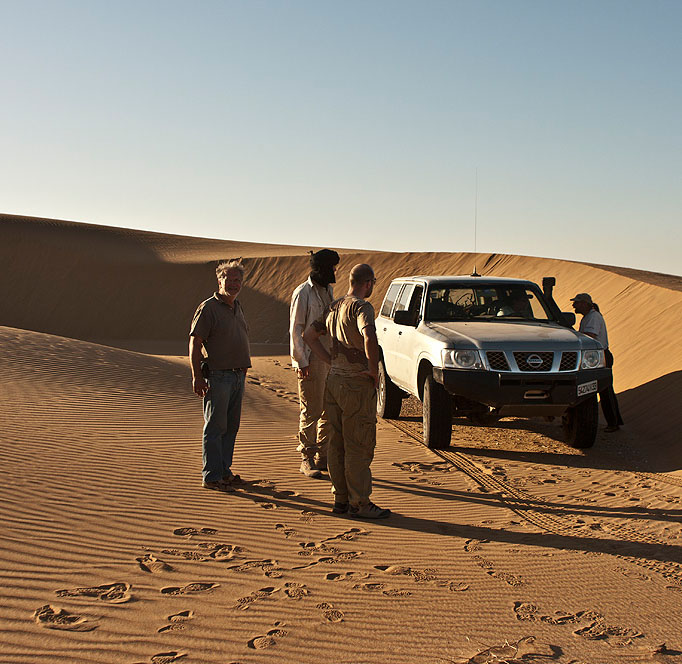
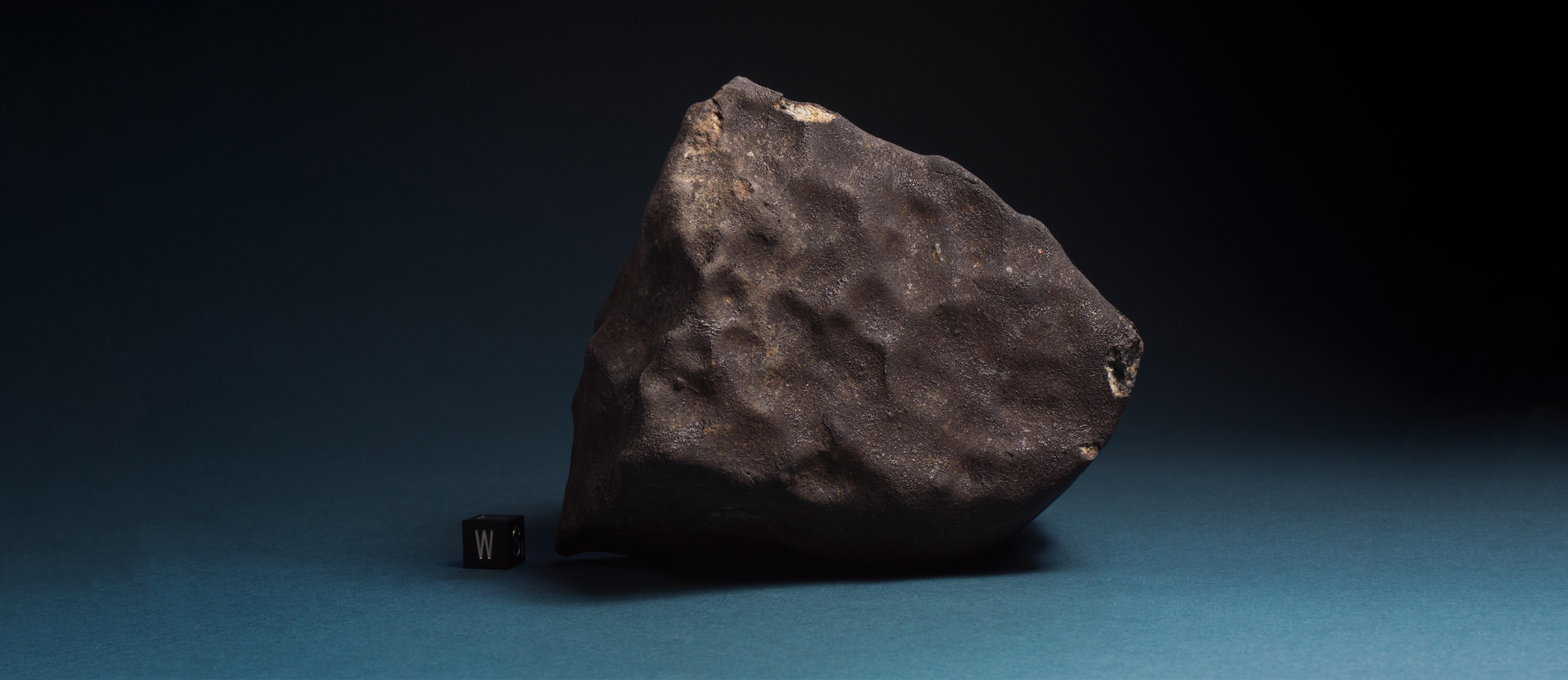
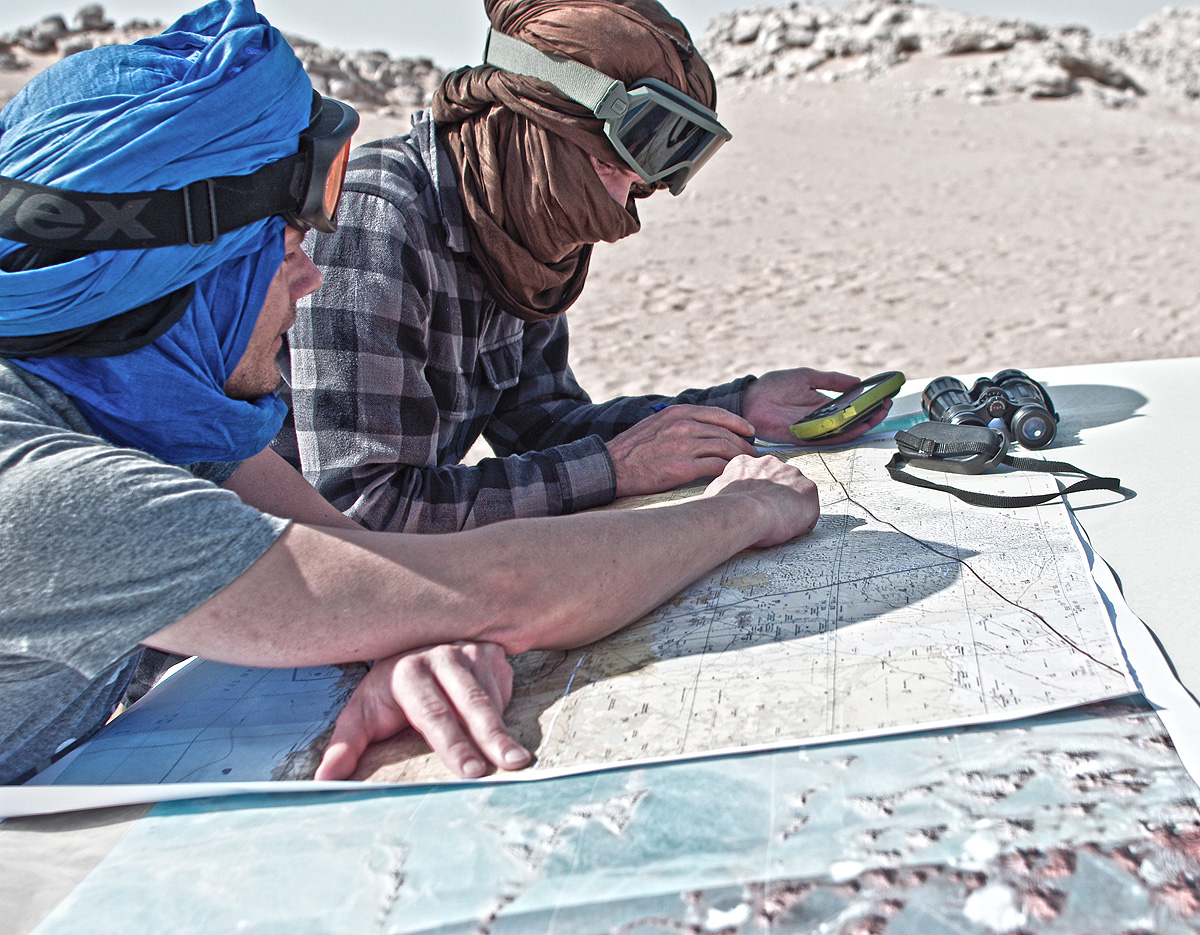
Thomas Kurtz (left) and author in front of a 488g chondrite ('Rub' al-Khali 006')
'We should measure and mark the site in our maps', I thought. If the graves had not been disturbed we might be even able to derivate evidence for the erosion gradient and and relative age of the top surface that we were searching. Provided the graves really were pre-Islamic and not oriented towards Mecca.

I took a bearing towards Thomas, collected him and together we returned driving in walking speed, careful not to miss other tell tale signs on the ground confirming a prehistoric settlement. The shallow stone heaps were hard to rediscover on the surface that was flickering in the heat. Although I had made a mental note of their position I spotted them not until we had come as close as seventy meters. 'Here we go', but in the same instant right below my window a black spot flashed by.

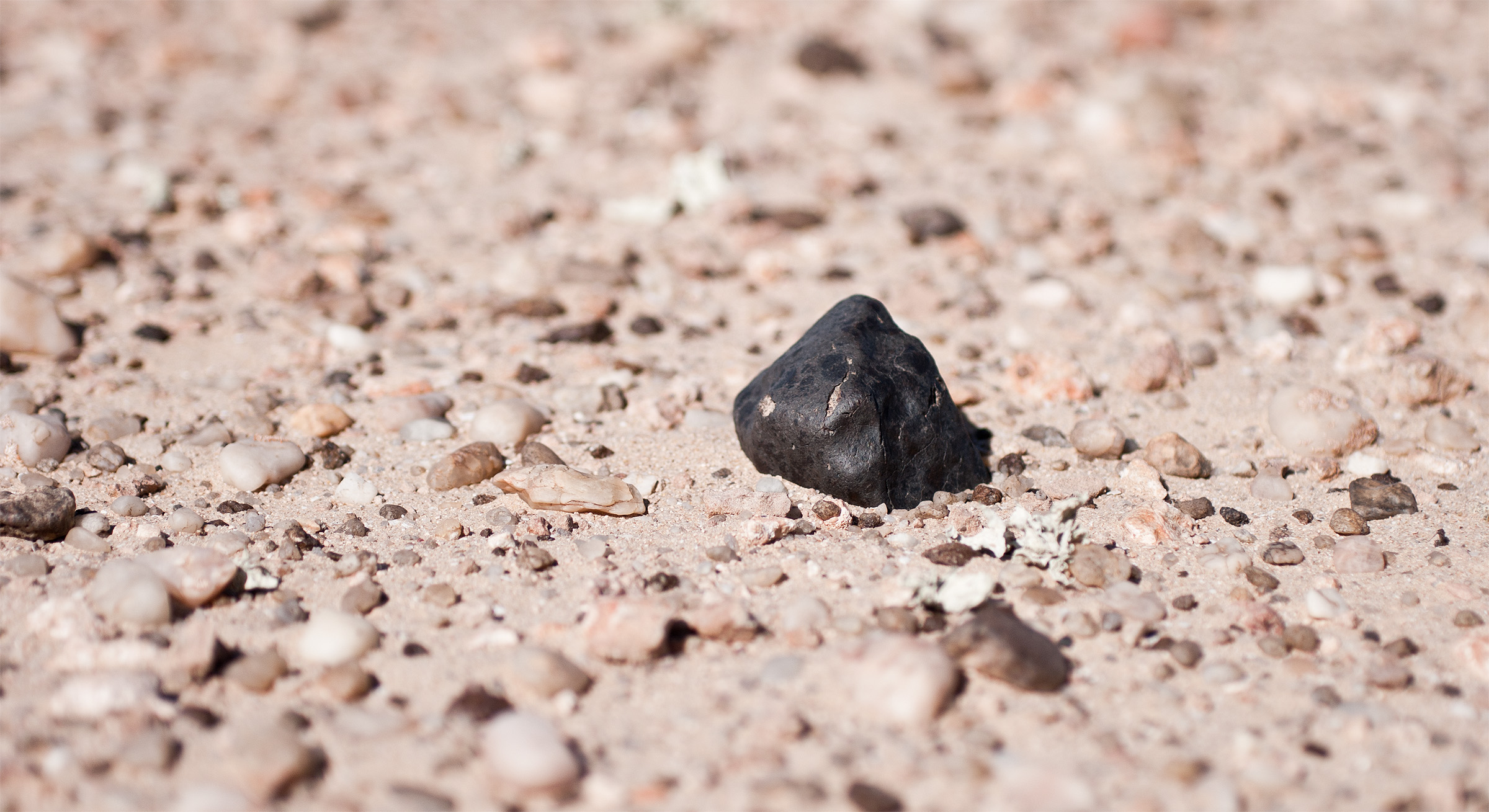
I turned my head while I continued driving but almost instantly slammed the brakes. Thomas, who could not see what I had seen curiously gazed at me. 'That looked good' I said and he directly knew what I meant. I opened the driver's door and once again looked at the rock that rested barely four meters behind the car.

In contrast to the bright gravel surface it was so black it seemed to come directly from the darkest corner of space. In fact it looked as if it was swallowing the light that was so lavishly distributed among this place. It's hard to explain but when you looked at this stone lying on the Serir of the Rub' al-Khali everything on it exclaimed its alien origin. 'This actually looks really good' I said.

click to continue

go to page 1 | 2 | 3 | 4 | 5 | 6 | 7 | 8 | 9


  © 2001-2008 Meteorite Recon