



|
|
|
|
www.niger-meteorite-recon.de
Meteorite scalecubes

Part one. The Origin of species
|

|
Picture 1. North arrow with integrated metric scalebar,
image courtesy of Cultural Technologies |
|
In the early 19th century the beginning of photography also lead to
new practices in the documentation of historic artefacts and natural
objects. To supply the viewer of an image with information on dimensions and the relative
position of an object, specific devices like the north arrow and the
metric photography scale bar came into use.
When Buchwald compiled his Handbook of Iron Meteorites in the mid
seventies of the past century, the metric scale bar was on every
meteorite curator's desk. Different models can be seen with many of
the specimen pictured in the three volumes of the Handbook since the
metric bar is the ideal reference scale for any object larger
than a man's fist.
But there was a certain kind of information the scale bar could not
transport. It was limited to a two-dimensional use. When the
same meteorite is shown in a series of photographs one
might want to know which surface is the one presented and how it
is related to the others. If a meteorite find is photographed in
situ, how do we secure information on its relative position?
If you have ever been confronted with the task to focus on both - not only
the meteorite in situ but also a GPS or a north arrow - then you will know the
problem.
|

|
Picture 2. Early type A scalecube pictured with
lunar meteorite MAC81005 recovered from the MacAlpine Hills Icefield in 1981.
Image courtesy of NASA
|
|
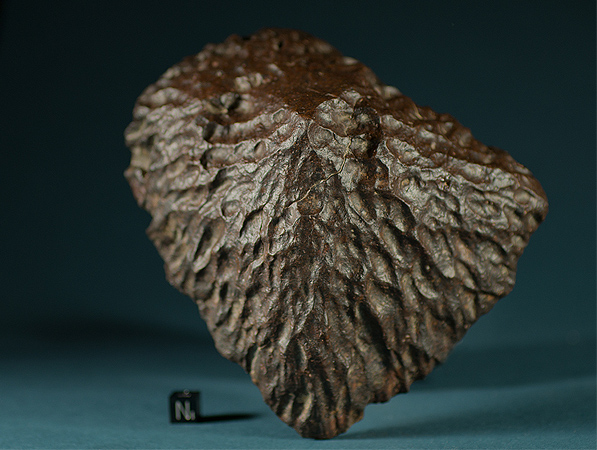
Like a deus ex machina an innovation hit the scene that could not
have had a greater impact on the conventions of meteorite photography:
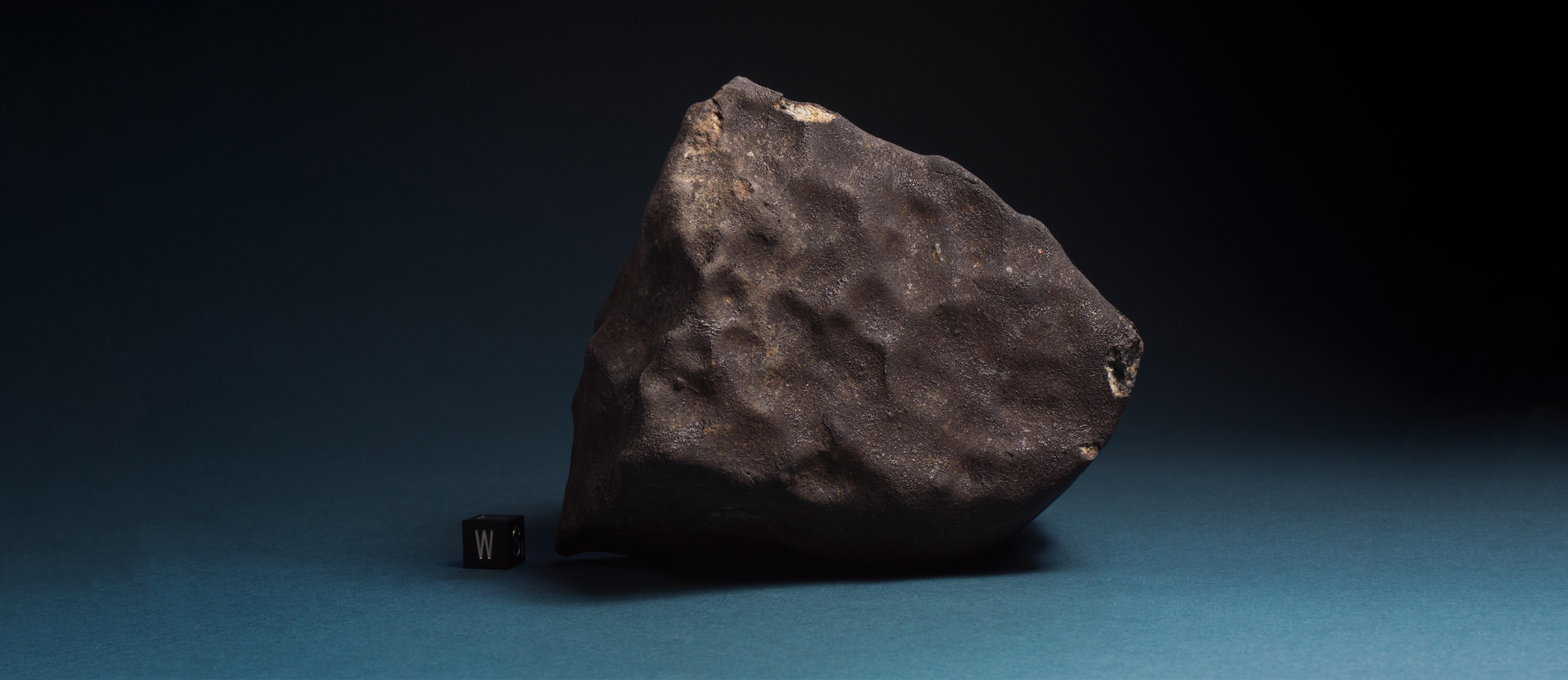
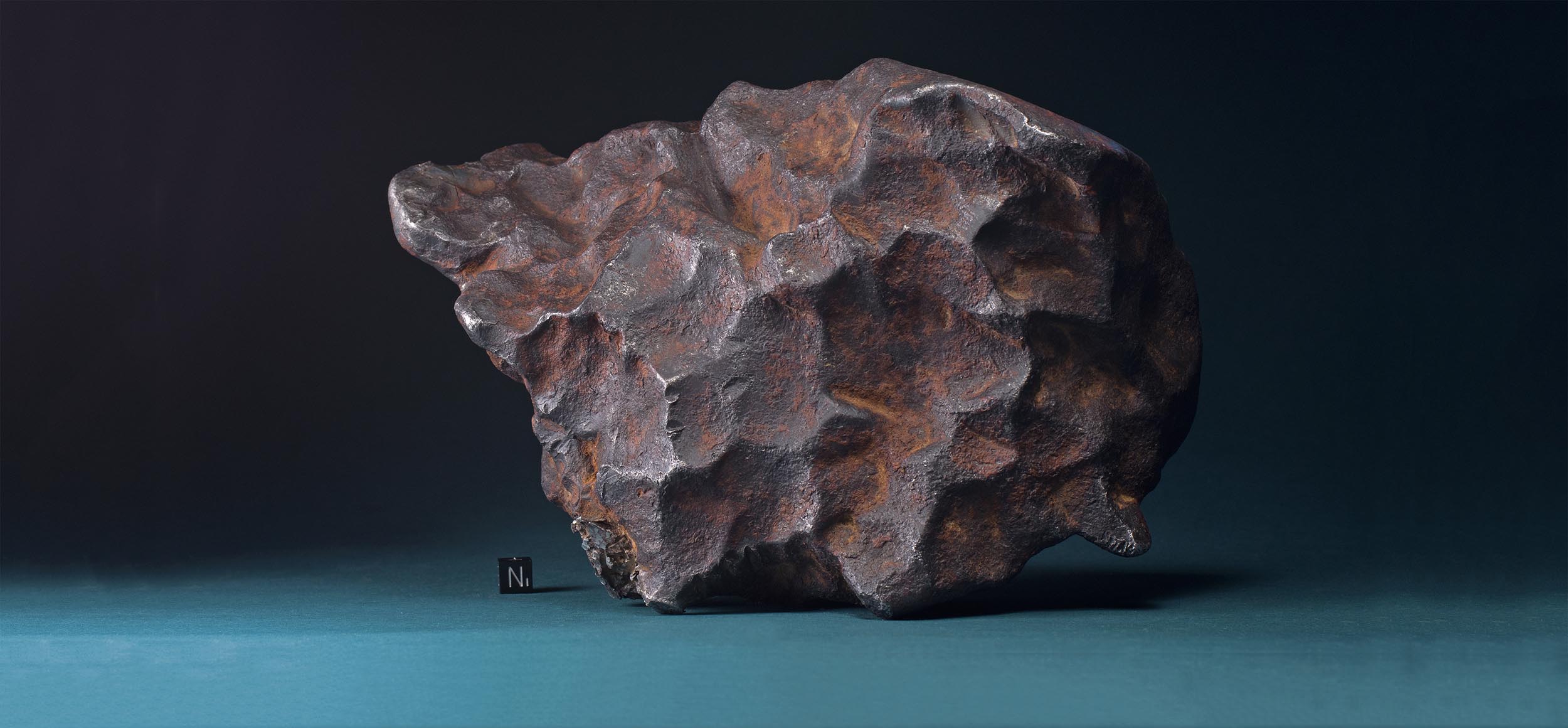
The meteorite scalecube, calibre 10 mm. Engraved with letters
representing both the cardinal points adittionally to top and bottom, the metric
scalecube elevated the genus of reference tools into the third
dimension.
We wanted to know who came up first with the cubic
invention, so we asked NASA but nobody there lay claim
to the revolutionary idea. More precisely we didn’t receive
an answer at all so we must assume that NASA keeps their scalecube
files restricted up to the present day. With no access to this
vital information, we were forced to push forward our own clandestine
investigation.
|

Picture 3. Same cube model, probably the same cube as used in
picture 1, this time sharing company with celebrity ALH 84001.
Image courtesy of NASA
|
|
Scanning through ANSMET archives, we found early photographs featuring
scalecubes dating back to the time of the cold war in the late
seventies. We have not yet been able to identify the mother of all cubes,
but the device displayed in picture 2 is without doubt a very
early version. The material seems to be solid metal, engraved letters
are approx 5 mm tall and less than 5 mm wide. This version already
has the vertical ‘I’ serving as a bottom indicator. The style of lettering seems to
be Arial narrow. In the following we will refer to this version as
the type A cube.
|

|
Picture 4. Russian cube model, unknown production date, pictured
with Sikhote Alin sample. Image courtesy of Vernadsky Institute, Moscow.
|
|
On the other side of the great pond NASA’s headstart in meteorite
scalecube technology did not stay unnoticed for long. The Russian academy
of sciences, known for their effective intelligence, countered the US
provocation with ease. Their answer was an easy to operate,
technologically less complicated and aesthetically pleasing cube.
Instead of Arrial Narrow the Vernadsky team used a plain Arial
font. Presumably to save production capacities, they decided to
spare the bottom indicator. But the major advantage of
the communist version was its large letters that could be read
clearly from a greater distance than the small inscriptions of the
US version.
The counterblow of the Vernadsky institute must have triggered an arms
race between the meteorite curators of both blocks. And NASA's reaction was
quick and determined. In the early eighties a new version of the
cube was launched. In order to demonstrate the regained superiority
in the field of meteorite photography reference tools, a
couple of images were
released that displayed their latest version.
|

Picture 5. Type B cube, pictured with Alan Hills 81005. Image courtesy of NASA.
|
|
The most
striking innovation of the new model was the common base line of
bottom indicator and capital letter. The broader font used in the
new model appears to be Lucida Console. And there is one more
distinguishing charactaristic of this model. The white stained
gravure shows zones where the edges look a little jagged. This
indicates the use of an aluminium alloy with a low share of silicium.
The thin anodized layer that gives the cube its bronzed black color
tends
to tear more easily when the material is worked with a milling head.
|

Picture 6. Vintage type A cube (right) and later type B version (left), pictured with L3
Chondrite Meteorite Hills 00506. Photo courtesy of NASA
|
|
After the cold war ended, NASA’s type A cube was put
into service again. A year 2000 photography
features both the older and the newer version in comparison.
Particularly interesting in this photograph (picture 6) is the fact that
two different versions of the cube were chosen to serve
as a reference device. Could it be possible that the reputation of the
powerful Space Agency ‘s meteorite documentation program based on the possession of just a single pair of cubes?
Click to continue
Part 1, "The Origin" | Part 2, "Renaissance" | Part 3, "The Next Generation"
|

|
© 2001-2009 MeteoriteRecon
|
|