

|
|
|
|
www.meteorite-recon.com
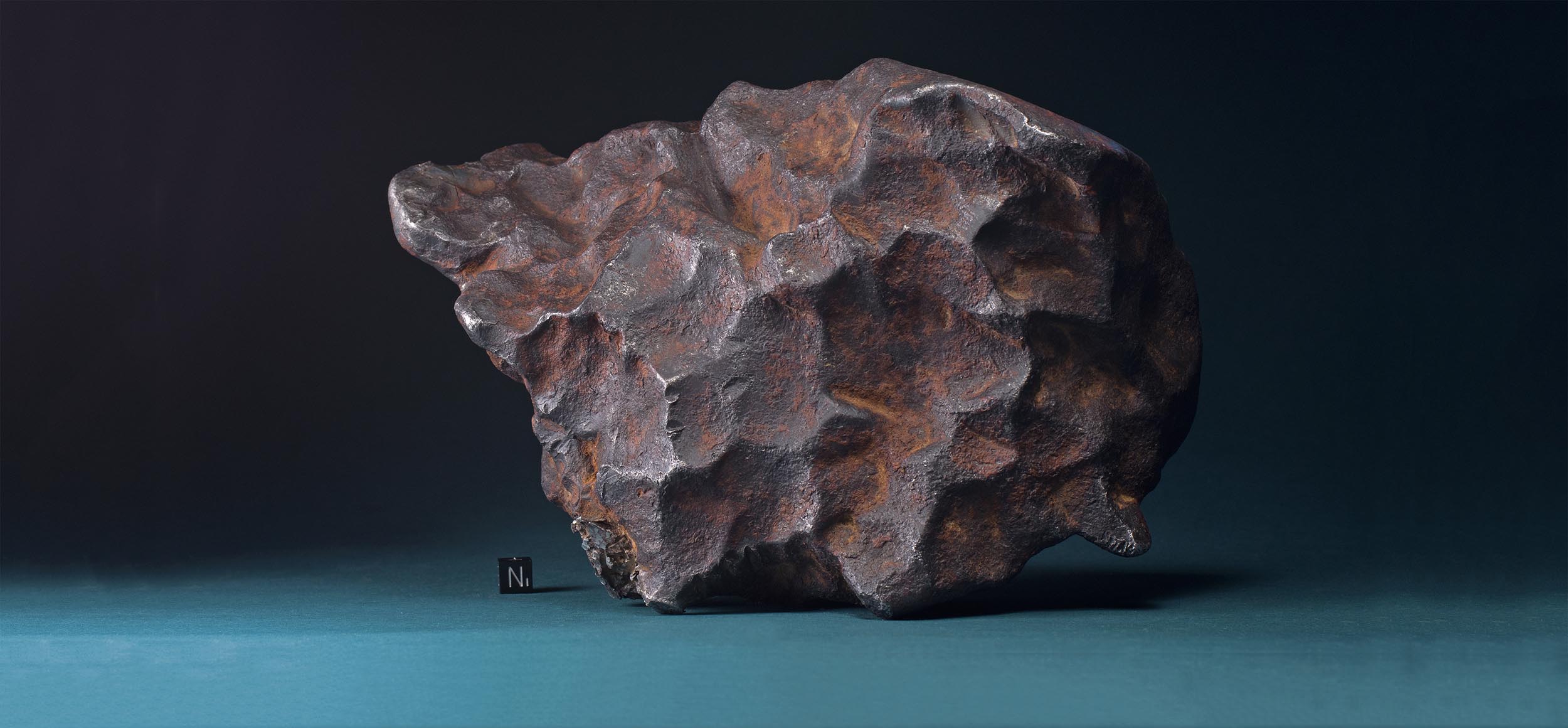
Meteorite scalecubes

Part 2. Renaissance
|

|
Picture 7. Only the find of a new Basaltic Shergottite would enable a
collector to acquire one of the sacred cubes. Picture by Ron Baalke shows LA001
found by Bob Verish in the selected
company of a NASA type B cube "The cube-scale that appears in the LA 001 image is
my first use of one. This particular cube-scale was
given to me by Paul Warren of UCLA. He said that it
came from NASA and is from the same mold as the other
"B" cubes". Bob Verish
|
|
Meanwhile an internationally growing community of meteorite
aficionados entered the world wide web. At first with analogue cameras,
later with digital equipment. Thousands of images displaying
various meteorites started to circulate. Many of these first
pictures lacked a standardised scale. The growing need for suitable
reference tools led to the excessive use of various
substitutes. Coins, pocket lighters, beer cans - whatever came in
handy joined the company of a
meteorite for the time of the shot.
At that time one person entered the scene who was about to materialise the meteorite
dealer's longings for a common standard into a solid block of
polyethylene terephthalate. He gave them a cube. Bob Verish
was the man who reinvented the scalecube for the meteorite community.
|

|
Picture 8. Bob Verish's personal type B cube performing desert duty at Silver Dry Lake in
March 2000. Meteorite pictured is an OC type L4, S2 with a weathering grade of W2.
Photo courtesy of Bob Verish.
|
|
His idea was as simple as ingenious. By accurately attaching capital
letters stamped out of a laminated film onto the plastic cube, he
achieved a striking effect. His low cost-high endurance innovation
became a multi-megaseller. Until present day hundreds of images on webpages,
including ours, show the unmistakable broad capitals with the
distinctive convex edges.
As a matter of fact the inspiration was born out of a necessity.
Let's hear Bob telling
the story with his own words: "The cube-scale that appears in the LA 001 image is
my first use of one. This particular cube-scale was
given to me by Paul Warren of UCLA. He said that it
came from NASA and is from the same mold as the other
"B" cubes. Ron Baalke is a good friend of mine and I
went to him for assistance in getting photos of LA 001
because it was going to be sliced-up the next day (I
couldn't take the photos myself because I had just
lost my camera at Gold Basin).
|

|
Picture 9. Same type B cube at Cuddeback Dry Lake in march 2000. Meteorite in situ is
an H6 ordinary chondrite. Note the dent at the edge of the cube's West and Top surfaces.
After some twenty years of service first at UCLA then at the California Meteorite
Recovery Team this specific cube was stolen while in a camera bag from the back seat
of a 1997 Ford Explorer in May 2000. Apparently the thieves were after the cube.
Photo courtesy of Bob Verish.
|
|
I continued to use this same cube-scale in many of my
images (in particular, my "in-situ" images, as well
as, on my eBay auctions) for the next few years.
Then I lost this "NASA" cube-scale when my camera bag
(and very first digital camera) were stolen out of my
truck one night."
"Prior to this time, I had made several attempts to
replicate this NASA style cube-scale, as well as had
several of my California meteorite-recovery
colleagues, but we could never find any cheap method.
Now that I was cubeless, I had to come up with a quick
and cheap replacement. I explained my predicament to
my M-Recovery Lab team members, and one of them,
Monika Waiblinger-Seabridge, offered to make some for
all of the M-RL team-members. She made a dozen of
them, and these are the first ones that were
distributed throughout the "amateur" meteorite
community. This particular set was coated in a
lacquer in order to help keep the lettering affixed.
Monika strove to replicate the NASA "B" style of cube
by using the subscript lettering."
Bob made these cubes available to a limited number
of fellow meteorite prospectors and dealers,
but he still considered the use of a cube-scale
as a personal USP. So it was his decision to forebear
from marketing the product on a wider base.
|

|
Picture 10. A Verish type cube together with a very familiar
looking Sahara 02500. Photo courtesy of Caillou-Noir.
|
|
But the mercyless reality of a deregulated market, like
the one for meteorite reference tools, didn't care
for the creator's intentions. The demand for the Verish-type
cube increased and it was just a question of time
before some foresighted person would recognize the
economic potential.
At this point of the story a strange phenomenon, resembling
strong similarities to the Widmanstätten - Thomson case, occured.
With Bob's concurrence a man started his cube production career
whose name would stick with scalecube history like the glossy
black crust to a Millbillillie. It was Peter Scherff who became
famous as the cube-scale tycoon. Until the present it's a common misconception that
the Verish-type cubes are Scherff-type cubes, but
actually, the opposite is the case.
By 2003 the plastic cube-scale distributed by Peter
Scherff was the most common reference tool seen on meteorite auctions at ebay.
But the availability of the new standard reference did not
only bring improvement. After heavy duty, the endurable Verish-cube
with the average calibre of 10.35 mm tends to lose it’s fusion
crust of acrylic lacquer, revealing a blue skin. We have seen
veterans of the first production line that underwent five or more
repaintings and are still in service.
Click to return to Part 1 or continue
Part 1, "The Origin of Species" | Part 1, "Renaissance"
| Part 3, "The Next Generation"
|

|
© 2001-2013 Meteorite Recon
|
|